Writing · Robot of the Month ·
Mechanical Ducklings on the March!
Read it in the November 2026 issue
 (open larger)
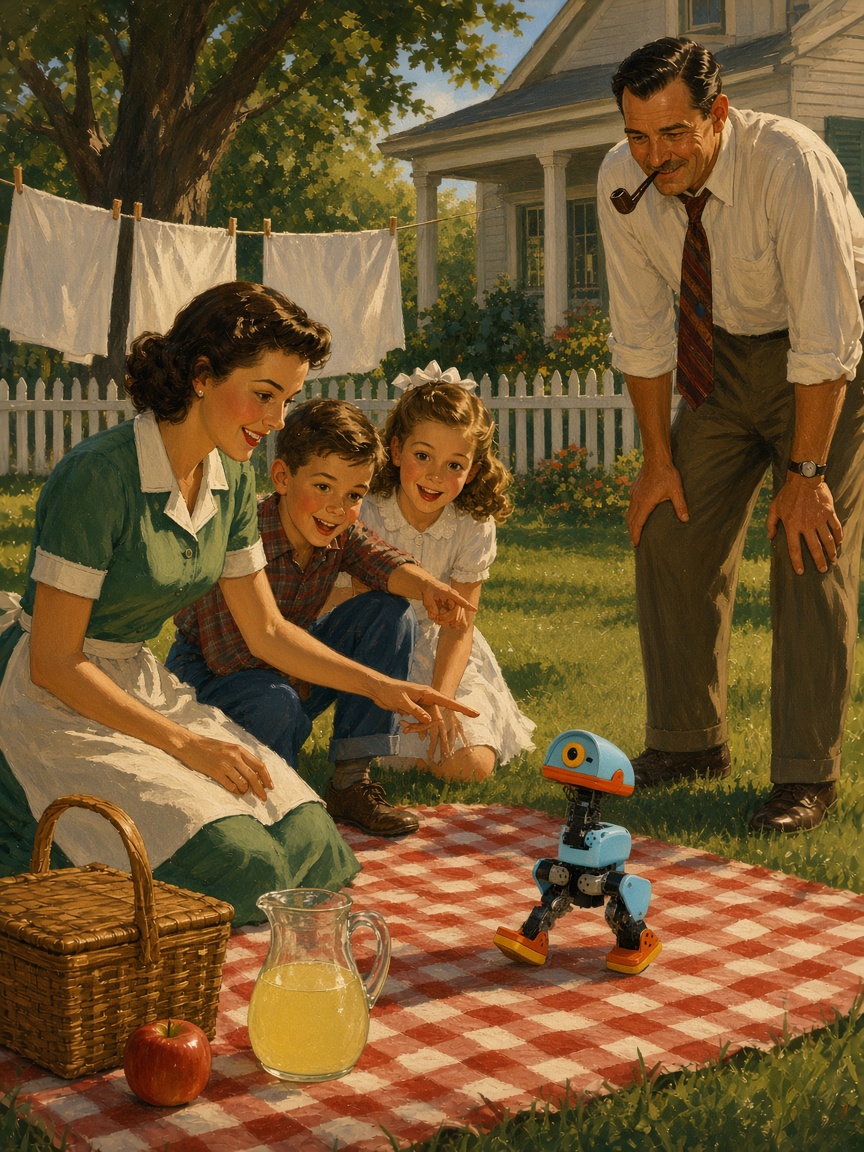
Here is a sight to stop a picnic cold: a little mechanical duck, about the size of a loaf of bread, waddling across the blanket on two legs as if it owned the place.
Its makers call the fellow a Microduck. A robot shop called Pollen Robotics, in Bordeaux, France, built it. They are now the robotics team at Hugging Face. It stands twenty-five centimeters tall, about ten inches, and it weighs under 800 grams, which is less than two pounds. Fifteen motors work the legs, the head, and the neck. A camera looks out from up front. And that beak is no decoration. It is hinged, and it can pick things up. It does not talk. It just makes a few weird little sounds of its own.
As it comes from the shop, the duck already knows its business. It walks, sits, kicks a ball, scoops things up in that beak, and, once you strap on its skates, even roller-skates. If it takes a tumble, it gets back on its feet by itself. You can boss it about with a little hand control before you write a single instruction.
Here is the real stunt. Before a duck ever sets foot on a floor, its makers build a twin of it inside one of those electronic brains, a three-dimensional model with true weight and balance, and set it loose in a make-believe world where a physics engine called MuJoCo works out gravity and friction to the last decimal. Engineers call this a simulation. There the simulated twin practices by trial and error, earning a good mark for every step that works and none for every tumble, until it has the knack. The trade calls this reinforcement learning, and the knack it ends up with, a policy. Then they send that same policy over to the real machine, a jump the engineers call sim-to-real, and the duck checks it fifty times a second as it goes. What the duck learned in that shadow-box, it does on the living-room floor.
It comes in four colors: Cream, Graphite, Lavender, and Sky. The Sky one is the little blue walker in our picture. You may put your name down for one now at $399, and the makers aim to have the first ducks at the door before Christmas.