Writing · In the Shop ·
Vision · Question · Premise · Decision
Read it in the November 2026 issue
This flywheel starts with a picture.
Every problem worth solving starts as a picture in somebody’s head. The trouble is that it’s a different picture in every head. Put ten people in a room and you get ten versions of the same problem, and nobody realizes it.
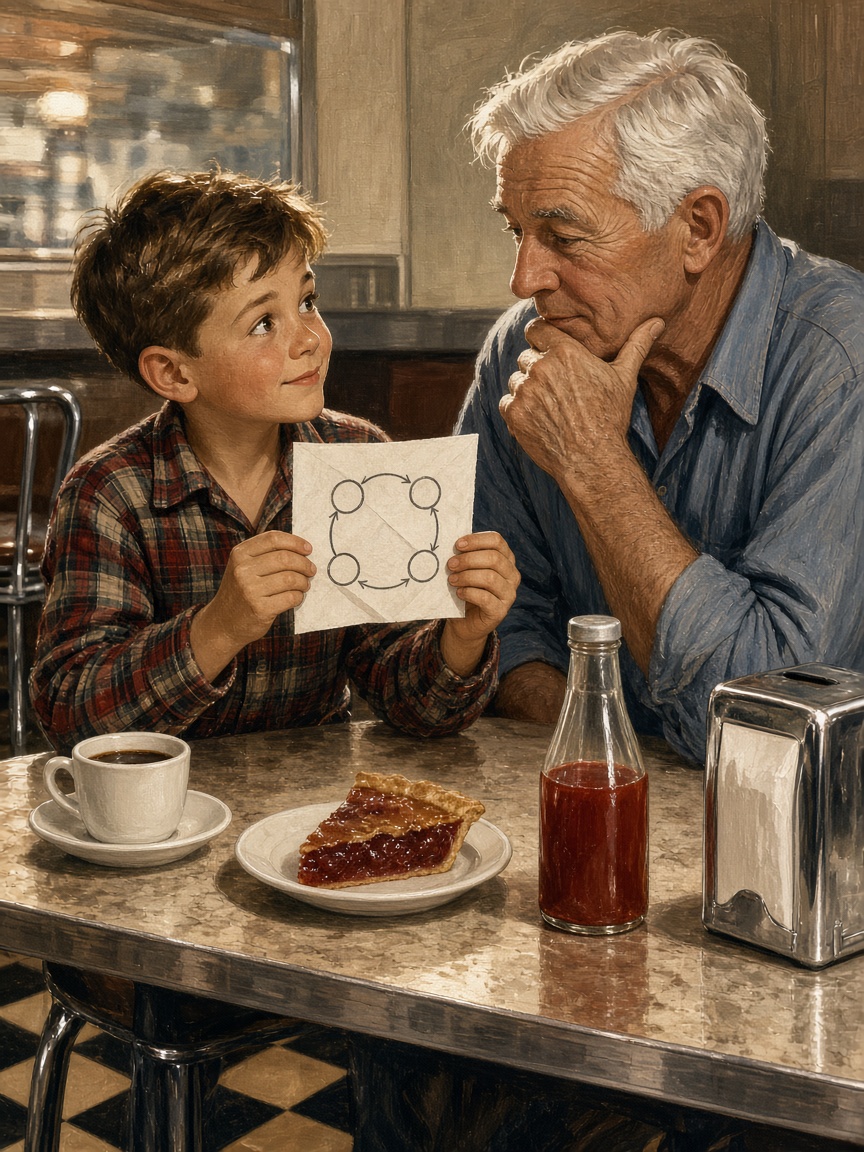
The napkin is the cheapest fix I know. Grab whatever’s on the table and draw the problem where everyone can see it. Once it’s on paper, everyone is finally talking about the same thing, and nobody has to hold the whole problem in their head while they work through the hard parts. It works for one person thinking alone, too.
That drawing is the first step of a loop I call V-Q-P-D: Vision, Question, Premise, Decision. It’s a flywheel, not a checklist. Each step feeds the next, and each lap makes all four clearer. It runs at every scale at once: a whole project, a single meeting, a single step of the loop.
The order matters. A correct decision on a bad premise is still the wrong answer. Get the premise right first, then cut aggressively.
The interactive napkin, with each step worked out in full, lives at toddhopkinson.com/napkin.
 (open larger)
- 1. Vision. Draw a picture. Put the essential elements in one place so nobody has to hold the whole thing in their head.
- 2. Question. Develop the golden question. Then ask why, and why again, until you reach the essential truths.
- 3. Premise. Keep what holds up. Throw out the rest. Get the premise wrong and everything built on it is a well-made mistake.
- 4. Decision. Decide for real: cut, change, or polish. Then act on it.