TODD HOPKINSON

MONTHLY · VOL. 1 · NO. 1 · NOVEMBER, 2026
Editor Todd Hopkinson
Art Todd Hopkinson with Grok, Gemini, and Midjourney
Publisher Lava Monster Labs, LLC.
Cover Raptor Generations
Site toddhopkinson.com
Offices Phoenix, Arizona

CONTENTS FOR NOVEMBER, 2026

On the cover: Raptor Generations.

Published by Lava Monster Labs, LLC. · toddhopkinson.com
November 2026. All inquiries through the site.

2   TODD HOPKINSON
From the Editor

Across the Street

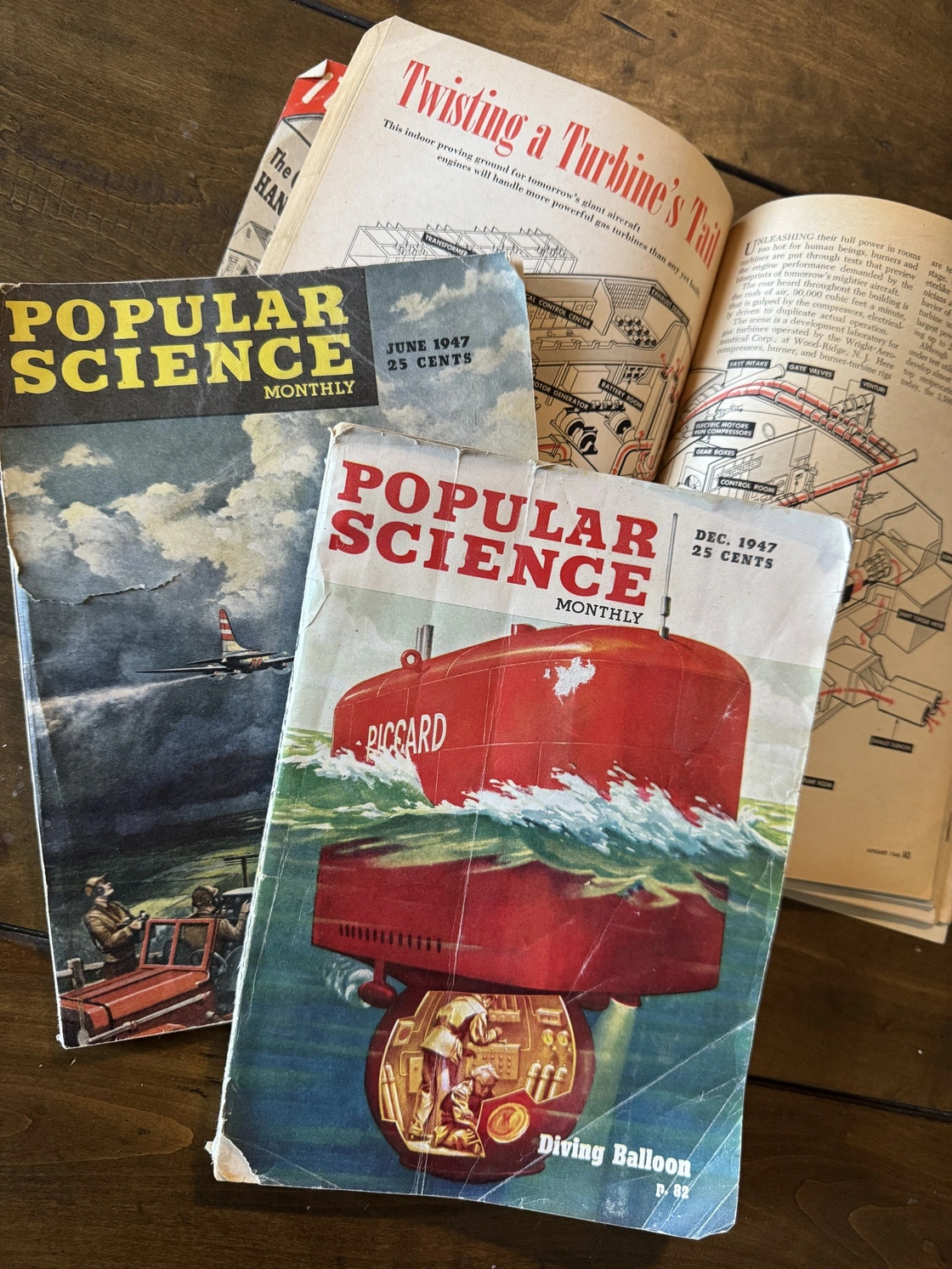
Welcome to the first issue of Todd Hopkinson Monthly. Its look is a tribute to the Popular Science and Popular Mechanics magazines I read as a kid, especially a stack of late-1940s and early-1950s Popular Science issues my grandpa kept, which now sits on my bookshelf.

June 1947 and December 1947 Popular Science magazines, with an open spread titled Twisting a Turbine’s Tail
Grandpa Fay’s Popular Science, June and December 1947.

My grandpa Fay Cozzens started as a roughneck in the oil fields and later became a plant manager for Montana-Dakota Utilities. My grandpa Harold Hopkinson was a Western artist. They lived across the street from each other. Going back and forth between their houses, I came to see making things, whether a machine or an oil painting, as one craft that joins art, science, and technology. That's what this magazine is for. I hope you find something here you enjoy, and something that sparks that same urge to create.

NOVEMBER 2026   3
Cover Story

The Best
Part Is
No Part

SpaceX stripped its Raptor engine bare. The engine lost about 105 kilograms. The rocket saved about a ton per engine.

Art by Todd Hopkinson with Grok, Gemini, and Midjourney

Raptor is the engine behind Starship, SpaceX's rocket built to fly into space, return, and fly again in short order. On the vehicles flying now, 39 Raptors do the lifting: 33 under the booster and 6 on the ship. Across three versions, SpaceX has raised the engine's thrust by 35 to 40 percent - to 250 tonnes on Raptor 3 - while cutting its weight by about a quarter.

But Raptor 3's biggest saving didn't show up on the engine at all.

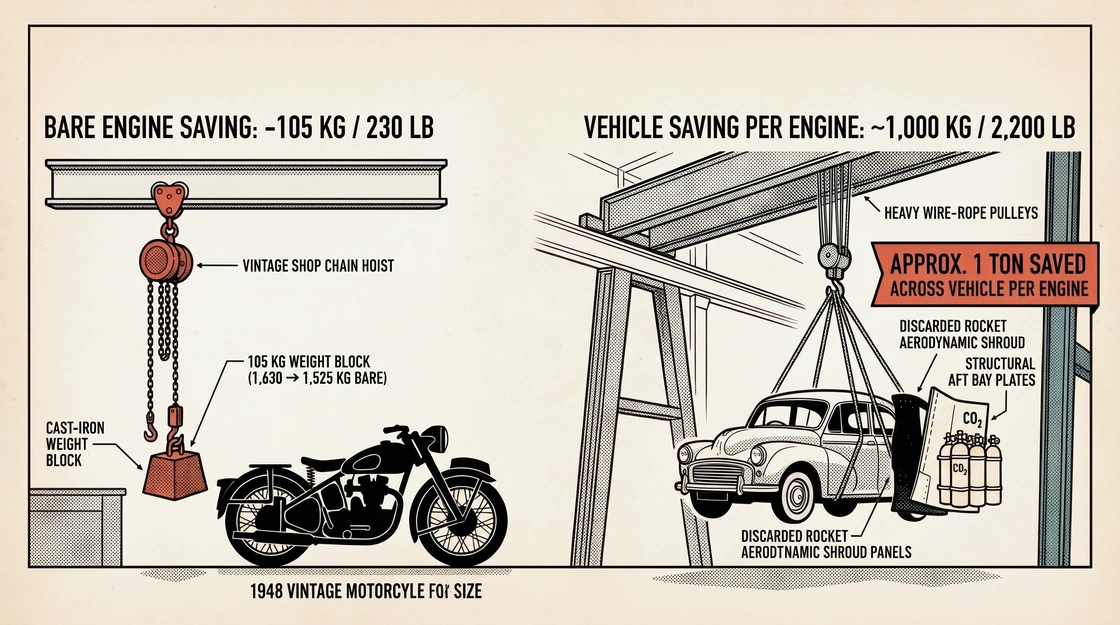
Raptor 2 weighed 1,630 kilograms bare. Raptor 3 weighs 1,525. That's 105 kilograms (about 230 pounds) lighter, or about 6 percent of the engine. Take 230 pounds off an engine and you'd expect the rocket to get 230 pounds lighter. Instead, SpaceX says the savings across the whole vehicle "reach approximately 1 ton per engine" - about 1,000 kilograms (2,200 pounds), roughly the weight of a small car and nearly ten times what the engine itself lost.

Two shop hoists drawn to scale: 105 kilograms off the bare engine on the left, about a ton off the rocket per engine on the right.

Fig. 2. Raptor 3 is about 105 kilograms lighter than Raptor 2 as a bare engine, but SpaceX puts the savings across the whole vehicle at about a ton per engine.

Art by Todd Hopkinson with Grok, Gemini, and Midjourney

Continued on page 14

12   TODD HOPKINSON
Painted lineup of Raptor 1, 2, and 3 on the test pad at dusk. The cover painting, Raptor Generations.
NOVEMBER 2026   13
The Best Part Is No Part - continued

Stripped to Bare Metal

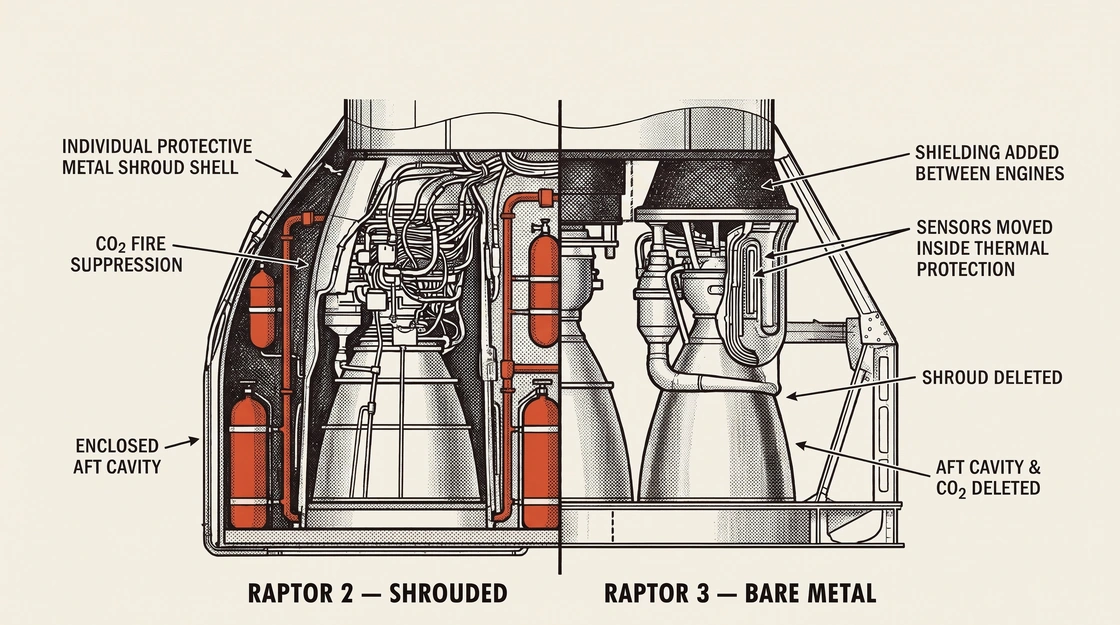
Split-centerline cutaway of a Super Heavy booster bay: Raptor 2 in its shroud and aft cavity on the left, Raptor 3 bare-metal on the right.

Fig. 1. On Raptor 3, SpaceX moved the sensors and controllers inside the engine's thermal protection and deleted the shroud. That let the booster drop the cavity around the engines and its fire-suppression system. The booster did add shielding between engines.

Art by Todd Hopkinson with Grok, Gemini, and Midjourney

Most of that saving came from equipment around the engine, not from the engine itself.

Put Raptor 3 next to Raptor 2 and the new one looks like somebody forgot to finish building it. Where earlier engines wore a tangle of small pipes, wires, and sensors - or hid them inside a protective cover called a shroud - Raptor 3 is smooth, bare metal. SpaceX tucked the sensors and controllers inside, under the engine's own thermal protection, and deleted the individual engine shrouds on both stages.

Bare doesn't mean unprotected. The engine still carries its own thermal protection, and the booster added shielding between its engines.

Continued on page 15

14   TODD HOPKINSON
The Best Part Is No Part - continued

Start from the Physics

"The best part is no part, the best process is no process." Elon Musk said that at a Starship presentation on September 28, 2019. He was talking about how SpaceX works in general. SpaceX wouldn't show Raptor 3 for almost five more years.

The idea underneath is older still. In a 2012 interview he described first principles as a way to "boil things down to the most fundamental truths" and "then reason up from there." His example was batteries, not rockets. Start from the physics, then ask what the part really has to be.

Cut First, Polish Later

In a 2021 interview, Musk gave a five-step order of operations: question the requirement, delete the part or process, simplify, speed up, automate. On step two, his words were "try very hard to delete the part or process."

The order matters. Deleting is step two. Making a thing better is step three. In a 2022 interview, standing next to Raptor hardware, he gave the reason: "possibly the single biggest mistake made by smart engineers is optimizing a thing that should not exist."

If you polish a part first, you may have spent your best hours on something you were about to throw away.

Continued on page 16

NOVEMBER 2026   15
The Best Part Is No Part - continued

Continued on page 17

16   TODD HOPKINSON
The Best Part Is No Part - continued

Fewer Bolts, Fewer Leaks

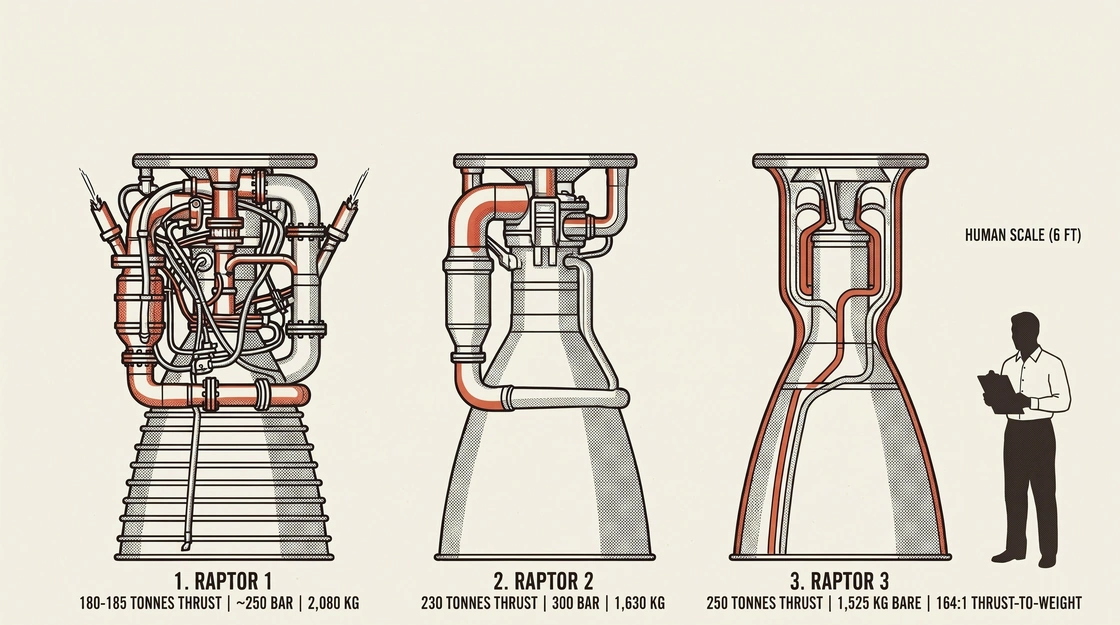
Raptor 1 made about 180 to 185 tonnes of thrust at roughly 250 bar. Raptor 2 made 230 tonnes at 300 bar. A tonne of thrust is the force it takes to hold up one metric ton against Earth's gravity. A bar is close to the air pressure at sea level. So 300 bar is about 4,350 psi, or about 124 times the pressure in a car tire set to 35 psi. It's roughly the water pressure 3 kilometers down in the ocean.

Raptor 2 was also lighter: 1,630 kilograms, against 2,080 reported for Raptor 1. That's about 450 kilograms gone in one generation. Raptor 3 took off another 105 and added 20 tonnes of thrust. A bare Raptor 3 now produces about 164 times its own weight in thrust. That's like a 70-kilogram person holding up 11.5 tonnes. It produces nearly three times the thrust of the sea-level Merlin engine on a Falcon 9.

“Sea-level” names the nozzle, not the altitude. The best nozzle shape depends on the air pushing back. Near the ground a sea-level engine needs a short bell, because a very wide one lets the exhaust pull away from its walls and shake the engine. In space there is no air, so a vacuum engine gets a long, wide bell that squeezes out more thrust. A sea-level Raptor can still fire in space; it just gives up some efficiency.

Three schematic Raptor generations side by side, each cleaner than the last, with a human silhouette for scale.

Fig. 4. Each Raptor generation deleted, combined, or moved parts, and the engine got lighter while its rated thrust went up.

Art by Todd Hopkinson with Grok, Gemini, and Midjourney

Musk described how it got there: "a massive amount of things have been deleted… deleted, combined, simplified, on Raptor 2 versus Raptor 1." The torch igniters on the main chamber came off, and the preburners kept simpler torch igniters. Musk wouldn't say how the main chamber lights now. He called it "secret sauce." Valves merged into single parts. Bolted joints gave way to welds.

Continued on page 18

NOVEMBER 2026   17
The Best Part Is No Part - continued

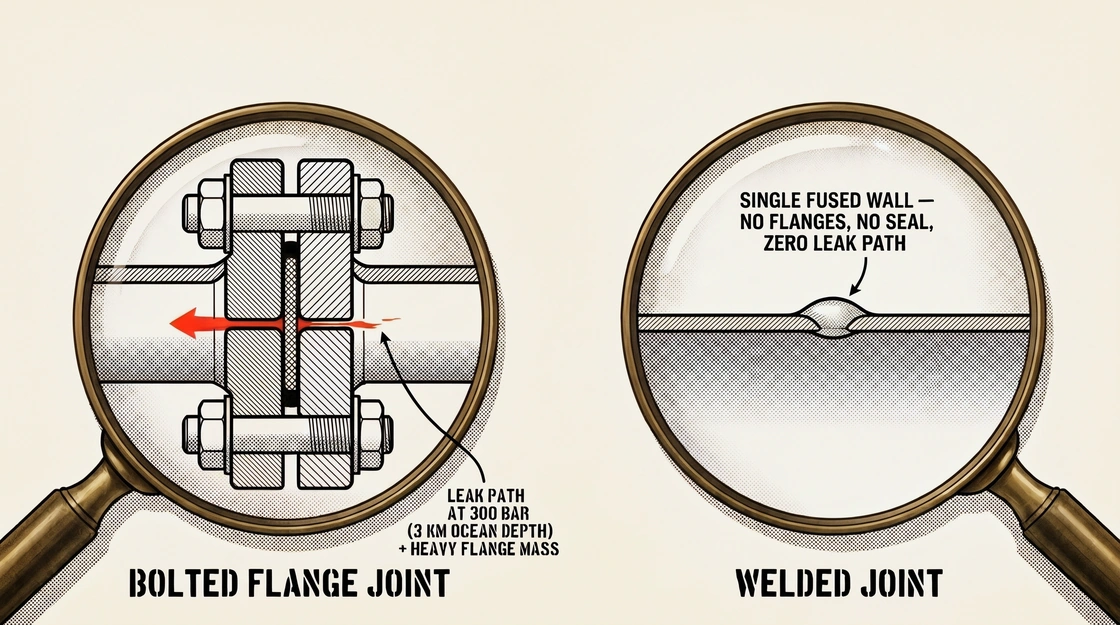
Joints matter because "every interface there has some leak rate that is above zero." A bolted joint needs heavy flanges, bolts, and a seal, and it has to hold everything from cryogenic liquid to hot oxygen-rich gas. A weld cuts the weight and a leak path in one move.

Two magnifying-glass cross-sections: a bolted flange joint with a leak path, and a welded joint fused into a single wall.

Fig. 5. At 300 bar - about 124 times the pressure in a car tire - every bolted flange and seal is both dead weight and a potential leak path. Welding fuses the pipe into a single wall.

Art by Todd Hopkinson with Grok, Gemini, and Midjourney

His priority in 2022 was explicit: "Right now, we're optimizing Raptor 2 for robustness, as opposed to performance." Next on his list was deleting more of the small loose parts and folding the pipes and wiring in far enough to get rid of the shrouds. He also named the catch: "if there's any part of the engine that is susceptible to heat, then we cannot delete the shroud."

The Shroud Took Its Plumbing With It

By May 2026 the shrouds were gone. Follow the chain.

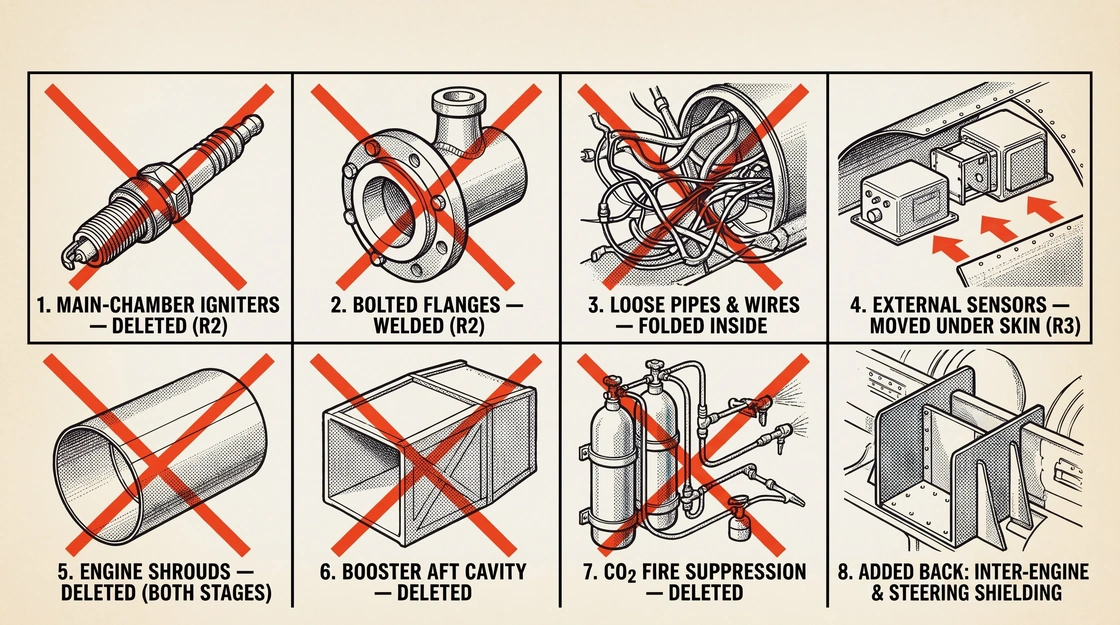
A shroud exists to protect parts that can't take heat. Move the sensors and controllers under the engine's thermal protection, and the shroud has no job. Delete the shroud, and the booster no longer needs the enclosed cavity around its engines. Delete the cavity, and it no longer needs the CO₂ fire-suppression system that protected it. On the ship, SpaceX rerouted the fluid and electrical lines at the back and deleted the large closed-off space there.

Continued on page 19

18   TODD HOPKINSON
The Best Part Is No Part - continued

SpaceX was already counting the engine and its surroundings together in 2024. Its announcement listed the engine at 1,525 kilograms and 1,720 kilograms with the vehicle-side fluids and hardware it needs.

The back of the ship had already caused trouble. After Flight 7 in 2025, SpaceX traced the ship's loss partly to leaks and fires in an aft compartment it calls the "attic," and said Raptor 3 would mean "eliminating the majority of joints that can leak into this volume."

The first iPhone made the same move. In 2007 the smartphones to beat, the BlackBerry and the Treo, carried a little plastic keyboard on the bottom half of their faces. Apple left it off, and the keys, the housing, and the half of the phone they filled went with it. The keyboard became software, so it showed up when you typed and got out of the way when you didn't. Steve Jobs put it plainly that June: you can "remove the keyboard when it's not needed, freeing iPhone's entire large screen." The whole face of the phone became screen.

Subtraction had a cost, and SpaceX says so. The booster gained shielding between engines and around the thrust-vector-control hardware, the gear that swivels the engines to steer. SpaceX redesigned the ignition system on every variant instead of removing it. Deleting a part moved some of the work. It didn't make all of it disappear.

Eight numbered hardware tiles: seven parts removed from the engine or its bay, and the shielding added back between the booster's engines.

Fig. 6. Removing a part on the engine sets off a chain reaction around it - though deleting the shrouds meant adding shielding back between the booster's engines.

Art by Todd Hopkinson with Grok, Gemini, and Midjourney

Continued on page 20

NOVEMBER 2026   19
The Best Part Is No Part - continued

Printed, Not Bolted Together

Many of Raptor 3's pipes went inside the engine's own walls, and 3D printing is a big part of how. Metal 3D printing builds a part from fine metal powder, one thin layer at a time, with a laser melting each layer onto the last. Because the part grows from nothing, it can have hollow channels inside it, and one printed piece can replace an assembly of several joined parts.

SpaceX leaned heavily on it for Raptor 3, Aviation Week reported, to fold plumbing and wiring that once hung on the outside into the engine's metal structure. Musk has said SpaceX has "the most advanced 3D metal printing technology in the world."

Jeff Thornburg, who ran propulsion at SpaceX, told 3DPrint.com that using additive manufacturing was "almost a foregone conclusion": "Elon wanted an engine in less than five years - and we had one on the stand in four. Additive made that possible."

How much is printed? SpaceX hasn't said, and no one outside the company has taken a Raptor apart in public. It also runs its own foundry for cast parts.

Trial by Flight

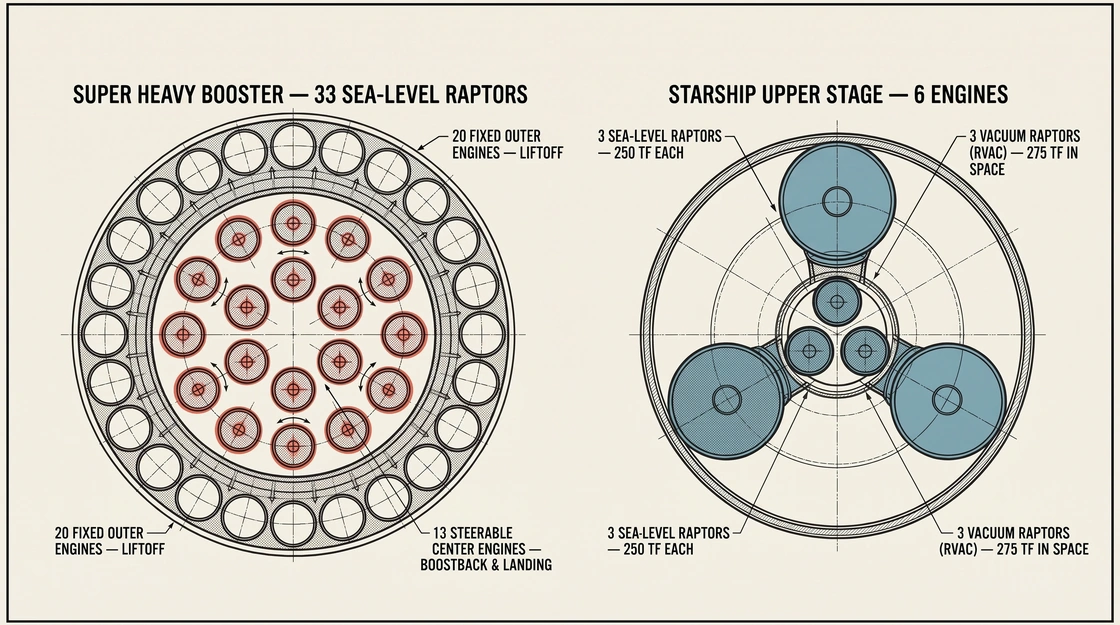
Looking up into the tails of Super Heavy and Starship: a 33-engine booster cluster and a six-engine ship cluster.

Fig. 7. Looking up into the tails of Super Heavy and Starship: 33 sea-level engines lift the booster, while the ship pairs three sea-level engines with three wide-nozzle vacuum Raptors.

Art by Todd Hopkinson with Grok, Gemini, and Midjourney

A cleaner engine only counts if it flies. Under the booster, an outer ring of 20 engines is fixed in place, and 13 center engines gimbal to steer and land the stage. Under the ship, three sea-level Raptors sit beside three vacuum Raptors (RVacs), which use larger nozzles to reach 275 tonnes of thrust in space.

Continued on page 21

20   TODD HOPKINSON
The Best Part Is No Part - continued

Raptor has real flight history. On Flight 5, October 13, 2024, the launch tower caught a returning booster for the first time. On Flight 6, November 19, 2024, a Raptor relit in space for the first time.

The 2025 flights showed the open problems. SpaceX tied the Flight 7 ship loss to strong vibration (harmonic response) and propulsion leaks. On Flight 8, booster relights failed because of heat conditions at the torch igniters, and a center-engine hardware failure that mixed propellants by accident destroyed the ship. Leaks and igniters were the same problems the Raptor 2 redesign went after.

Raptor 3 first flew on Flight 12, May 22, 2026. All 33 booster engines lit. One shut down on the way up, the booster didn't light all its planned boostback engines, and it splashed down hard. The ship lost one RVac and still reached its planned path. On Flight 13, July 24, all six ship engines finished the climb and one relit in space.

On Flight 14, September 28, Starship reached orbit for the first time. The booster relit 31 of 33 planned engines for boostback and 11 of 13 for landing. One ship RVac shut down early, and the others burned longer to make up for it. A sea-level Raptor did the orbital insertion burn, and the mission deployed 26 Starlink V3 satellites. Another single-engine burn brought the ship out of orbit, and all three sea-level Raptors lit for the landing burn.

As of October 30, 2025, SpaceX had built more than 600 Raptors, with over 226,000 seconds of Raptor 2 run time and over 40,000 seconds of Raptor 3. Forty thousand seconds is about 11 hours.

More Thrust from the Same Weight

Teslarati reported on October 26, 2026, that Musk's target for Raptor 4 is 300 tonnes of thrust at roughly Raptor 3's mass. I couldn't find Musk's original post, and no date, pressure, or test result is public. It's a target, not hardware.

Notice the direction. The first two rounds took weight off. The next one, if it happens, holds the weight and adds thrust.

The Hidden Weight of Every Part

Steve Jobs did this to a whole company. Back at Apple in 1997, he drew four squares: consumer and pro, desktop and portable. Macworld later summed up the rule: "Anything that didn't fit in that grid got cut." Apple cut more than 70 percent of its hardware and software products, the Newton among them. It also ended the program that licensed Mac clones. Every product he cut took with it everything that existed only to build, sell, and support it. What was left, in Macworld's words, was "a handful of good products, rather than a menagerie of mediocre ones." To me, the grid is the same lesson as Raptor, applied to a company.

The part you remove is rarely the whole saving. The savings come from everything that part needed.

END

NOVEMBER 2026   21
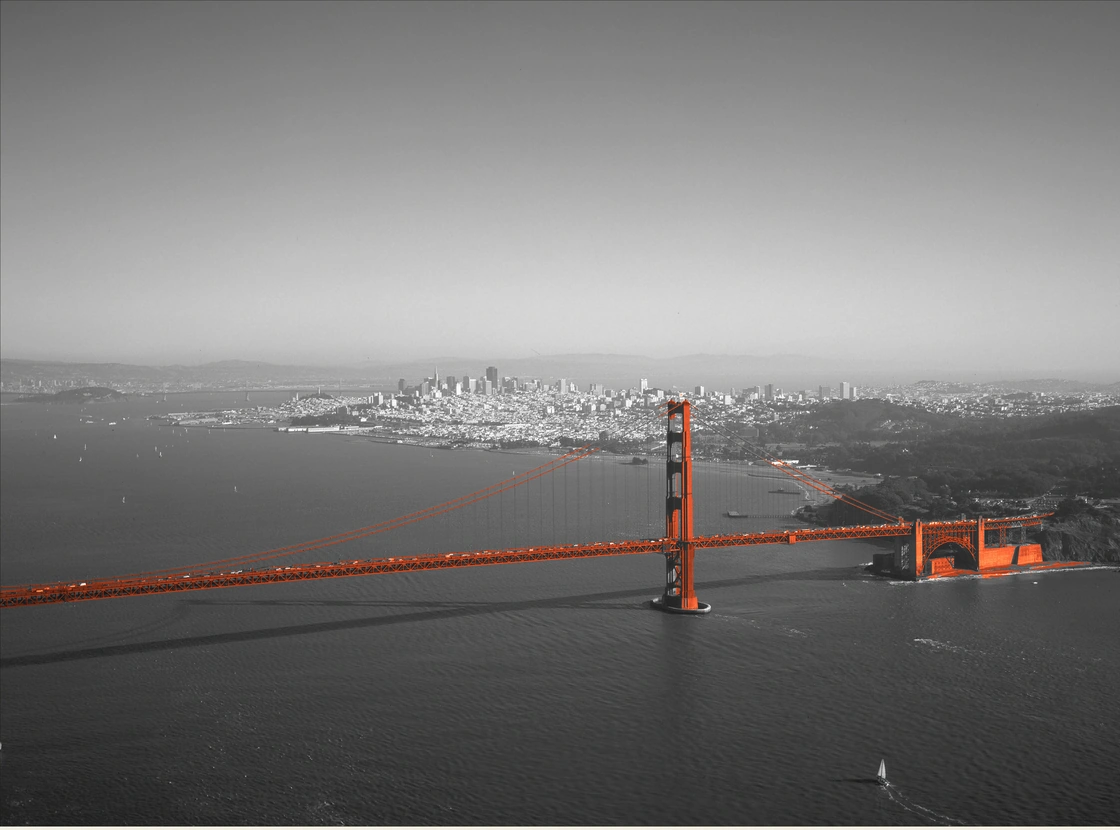
The Golden Gate Bridge in black and white, with the painted steel held in International Orange. A cropped detail of the plate on page 45.

Carol M. Highsmith, Golden Gate Bridge, San Francisco, California. The full plate is on page 45.

A Builder's Lexicon

A Builder's Lexicon

Art, science, technology, design.

“As everyone knows, words constantly take on new meanings. Since these do not necessarily, nor even usually, obliterate the old ones, we should picture this process not on the analogy of an insect undergoing metamorphoses but rather on that of a tree throwing out new branches, which themselves throw out subordinate branches; in fact, as ramification.”C. S. Lewis, Studies in Words (1960)

Oxford Languages defines technology as "the application of scientific knowledge for practical purposes" (Lexico, archived). The word comes from the Greek tekhnologia, built on tekhnē: art, skill, craft in work, a method of making or doing (Etymonline).

At its root, technology grows out of art and craft. Tekhnē was one Greek word for art, skill, and craft. English split it three ways, into art, craft, and technology. Underneath all three sits one test, written down by a Roman architect more than two thousand years ago: anything built has to stand, work, and delight.

36   TODD HOPKINSON
A Builder's Lexicon - continued

Art Used to Mean Skill

Art went through the same split. When it came into English in the 1200s, it meant any skill learned by study and practice. The sense of "creative arts" shows up around the 1610s, and painting and sculpture in particular around the 1660s (Etymonline). The old meaning never died. It's still there in liberal arts, state of the art, and the art of war.

Raymond Williams, in Culture and Society, traces how art went from any human skill to a select group of imaginative skills, and how artist, once a skilled person like an artisan, came to mean only those. Larry Shiner, in The Invention of Art, describes the split more sharply and dates it to the eighteenth century: "After over two thousand years of signifying any human activity performed with skill and grace, the concept of art was split apart," into fine arts on one side and crafts on the other (2001, p. 5).

That's the tree from C. S. Lewis's quote above. His trunk is the old meaning of art: any skill learned by practice. The new branch has so outgrown the trunk that most people think art only means the fine arts.

Tekton

Go one step further back. Tekhnē shares a root with tektōn, the Greek word for builder or carpenter. Both words come from an old root meaning "to weave," and also "to fabricate." Put arkhi-, "chief," in front of tektōn and you get arkhitektōn, master builder, which gives us architect (Etymonline). Old English had its own word for an architect: heahcræftiga, "high-crafter."

The Gospels were written in Greek. Mark calls Jesus ho tektōn, "the builder" (Mark 6:3).1 Matthew calls him tou tektonos huios, "the builder's son" (Matthew 13:55).2 The translators of the Septuagint had already used tektōn for the Hebrew חָרָשׁ (ḥārāš), a worker in wood, stone, or metal. In 2 Samuel 5:11, Hiram sends craftsmen of wood and of stone, and the Greek calls both tektonas. Isaiah 44:12 uses the same Hebrew word, and the same Greek, for a worker in iron.

Weaver, carpenter, craftsman, artist, architect, technologist - one family, different branches of Lewis's tree.

NOVEMBER 2026   37
A Builder's Lexicon - continued

Craft

Old English cræft first meant power or strength. During the Old English period it grew to mean skill, art, even science, and by late Old English a trade that takes special skill, or something built or made.3 German Kraft is the same word, and it still means strength. The heahcræftiga, the "high-crafter" from page 37, was a master of this craft.

The verb had a rougher ride. Old English cræftan meant to build. "To make skilfully" shows up in the early 1400s, drops out in the 1500s, and comes back around 1954, mostly in American advertising.3 Every "handcrafted" label on a grocery shelf is using a word that sat unused for about four hundred years.

Science

Science comes through French from Latin scientia, "knowledge," from scire, "to know." The Latin verb probably first meant to separate one thing from another, and is related to scindere, "to cut."4

It started broad in English too. Around 1400 science could mean a skill gained by training, a handicraft, a trade. Using it for everything that isn't the arts dates from the 1670s. The narrow sense most people mean today, the natural and physical sciences, dates from the mid-1800s.4

The person who does science got a name even later. William Whewell coined scientist in 1834, and he built it on the model of artist. "As an Artist is a Musician, Painter, or Poet," he wrote in 1840, "a Scientist is a Mathematician, Physicist, or Naturalist."5 The scientist was named after the artist.

Engineering

Engine comes from Latin ingenium, "innate qualities, ability," literally what is inborn. In Late Latin it also named a war engine, a battering ram. When it came into English around 1300, engine could mean a machine, and also skill, craft, natural talent, and trickery.6

An engineer, in the mid-1300s, built military engines. The broader sense of inventor or designer came in the early 1400s. Engineers of public works appear around 1600, but that wasn't the common meaning until the 1800s, which is why we still say civil engineer.7

Vitruvius, the Roman architect, kept Julius Caesar's artillery working.8 Milan listed the painter Leonardo da Vinci as ingeniarius, an engineer.16 The root of engineer meant a talent in a person before it meant a machine in a field.

38   TODD HOPKINSON
A Builder's Lexicon - continued

Poet and Wright

Poet comes from Greek poiētēs, "maker, author," from poiein, "to make, create, compose." In the 1500s and 1600s English often just called a poet a maker. George Puttenham said it plainly in 1589: "A Poet is as much to say as a maker."9

Old English had its own word for a maker: wyrhta, "worker, maker," from wyrcan, "to work." That's our wright. A wheelwright makes wheels and a playwright makes plays. Old English even had leoþ-wyrhta for a poet, literally a song-wright.10

Pindar called poets tektones of verses, builders.2 Greek and Old English got to the same place on their own. The person who writes a poem and the person who builds a wagon share a job title.

Polymath

Polymath came into English in the 1620s from Greek polymathēs, "having learned much," from polys, "much," and the root of manthanein, "to learn."11 Mathematics grows from the same root.

The word describes what a person learned. Engineer describes what a person does with it: aptitude and experience, put to work. A builder needs both. The label usually goes to Leonardo. Whewell, the man who named the scientist after the artist, gets it too.5

Creative

Create comes from Latin creare, "to make, bring forth, produce," related to crescere, "to grow." The Latin etymologist Michiel de Vaan writes that its original meaning was "to make grow."12

Creative shows up in the 1670s, meaning "having the quality or function of creating." Its use for literature and art, meaning "imaginative," dates from 1816, in Wordsworth, and creative writing from 1848.13

Creative went the way of art. It started as any kind of making and narrowed to the arts. When a company calls its designers "the creatives" and treats its engineers as something else, it's relying on a meaning of creative only about two hundred years new. The older meaning covered anyone who makes things, engineers included.

Design

Design comes from Latin designare, "to mark out, point out, devise," from de-, "out," and signare, "to mark," from signum, a sign.14 In the 1500s the Italian disegnare picked up two meanings at once: to plan or intend, and to draw. French split them into two spellings, dessein for a plan and dessin for a drawing. English kept one word for both.14

Giorgio Vasari, the painter and architect who wrote the Lives of the Renaissance artists (1568), used disegno in a line about Leonardo: "tutte quelle ove il disegno si interveniva," every profession where design played a role.15 In Italian and in English, the drawing and the intent are the same word.

NOVEMBER 2026   39
A Builder's Lexicon - continued

When someone tells me they're "not a technical person" or "not an art person," the language disagrees with them. For most of its history, making a beautiful thing and making a working thing were one skill with one name.

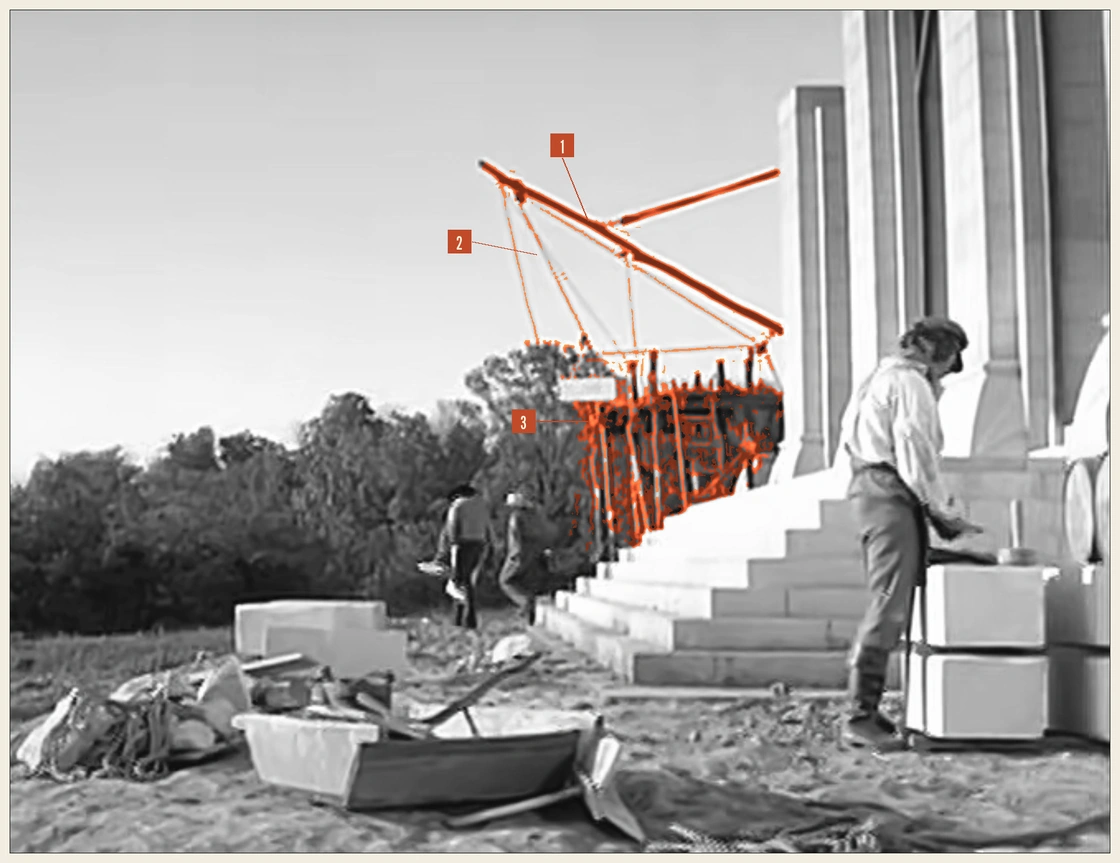
I keep seeing art and engineering turn out to be the same act. When my father, Glen Hopkinson, was painting the storyboards for Legacy, a film by Academy Award–winning director Kieth Merrill, he painted the architectural hoist that one scene called for. Later, on the actual set, it amused Dad to see that the set builders had built a faithful version of his hoisting contraption from the storyboard. A thing of beauty on a storyboard became a thing that actually worked. Dad had engineered the contraption on the spot in paint, being both the engineer and the artist intertwined in one creator.

On the set.
Still from Legacy: a timber hoist beside a stone building, with the boom, rigging, and tower picked out in red.

A still from Legacy showing the hoist the set builders constructed from Glen Hopkinson’s storyboard.

  • 1 Boom
  • 2 Rigging
  • 3 Tower

Still from Legacy, dir. Kieth Merrill.

40   TODD HOPKINSON
A Builder's Lexicon - continued

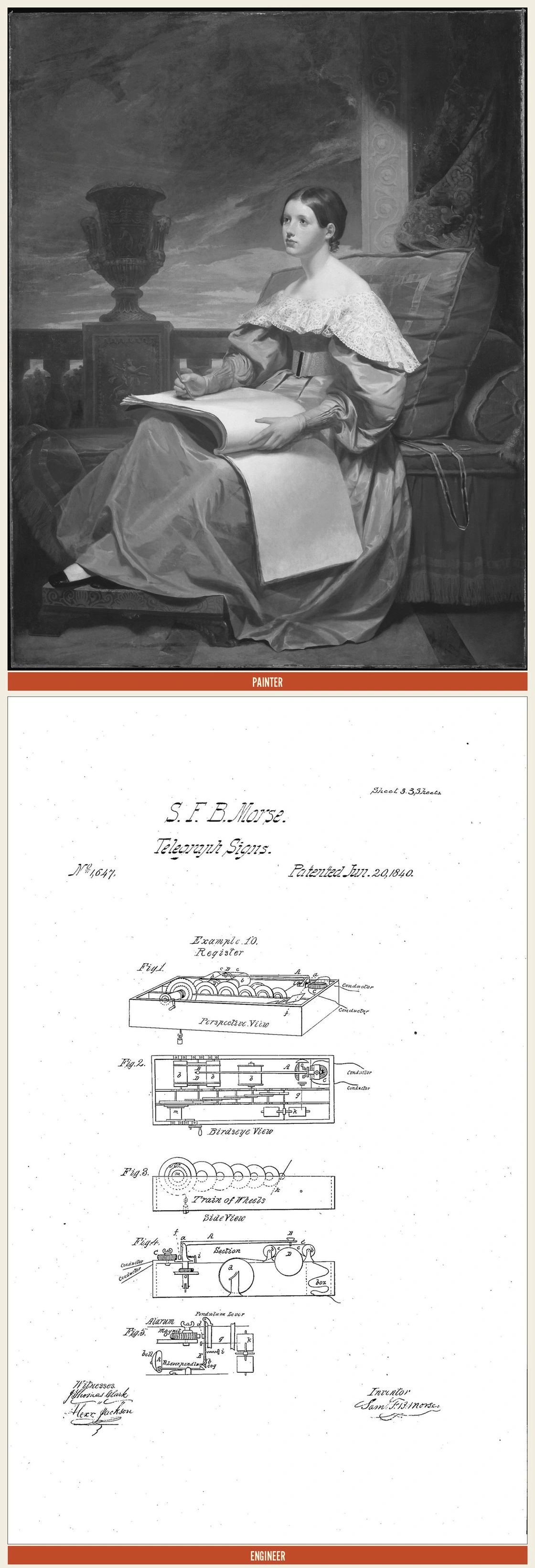
This coupling of art and engineering reminds me of Samuel F. B. Morse, the portrait painter who also co-invented the electric telegraph. And it brings to mind Leonardo da Vinci, whom a Milanese list of engineers from the 1490s calls ingeniarius et pinctor, "engineer and painter."16 Cesare Borgia named him "Architect and General Engineer."30

An anonymous biographer, writing a generation after his death, described Leonardo as skilled in mathematics, perspective, sculpture, and the lute, and "well versed in artillery, aqueducts, and other fantastic inventions."17 He is history's best-known polymath, and one drawing shows why. Around 1490 he drew a man inside a circle and a square, a figure Vitruvius described.24 We know it as Vitruvian Man.18

The drawing, on the following page.

Samuel F. B. Morse’s portrait of his daughter Susan, in grayscale, stacked above his 1840 telegraph-register patent drawing. Red slugs under the panels read Painter and Engineer.

PAINTER / ENGINEER. His daughter Susan, painted just before the telegraph patent; below, the recording register from that patent.

Samuel F. B. Morse, Susan Walker Morse (The Muse), ca. 1836–37. The Met, object 11605. Public domain (PD-Art). U.S. Patent 1,647, 20 June 1840, sheet 3, “Example 10. Register.” Public domain.

NOVEMBER 2026   41
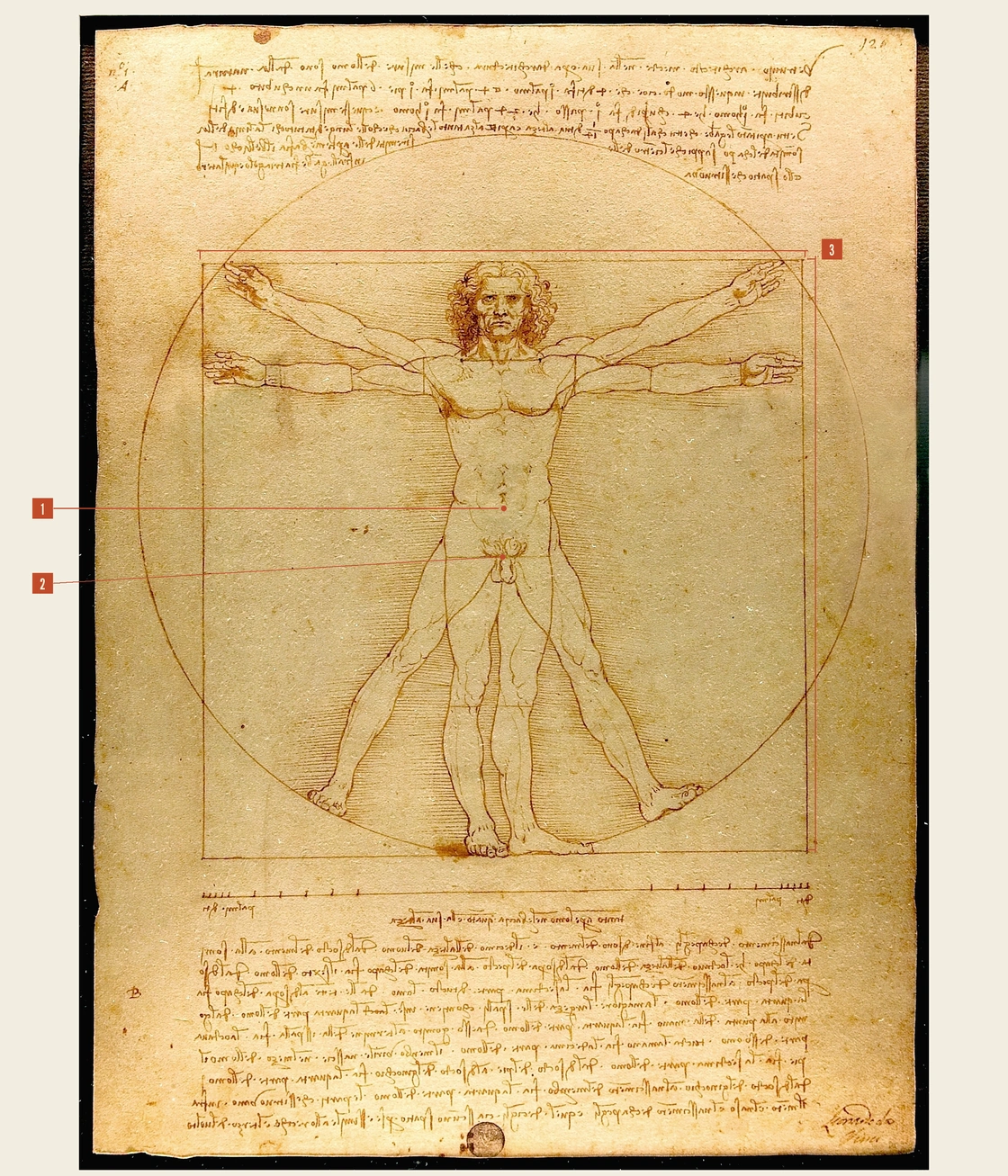
Leonardo da Vinci’s Vitruvian Man, c. 1490, with three red numbered callouts: 1 at the navel, the center of the circle; 2 at the groin, the center of the square; 3 at the right fingertip, marking that arm span equals height.
Vitruvian Man

Leonardo da Vinci, c. 1490. Gallerie dell’Accademia, Venice. The numbered callouts are keyed on the facing page.

Public-domain photograph of a two-dimensional public-domain work (PD-Art). Wikimedia Commons, File:Da Vinci Vitruve Luc Viatour.jpg, photograph by Luc Viatour, 8 September 2007.

42   TODD HOPKINSON
A Builder's Lexicon - continued
  1. 1
    Navel. Center of the circle.
  2. 2
    Groin. Center of the square.
  3. 3
    Arm span = height. The square: fingertip to fingertip equals crown to heel.

Leonardo took that figure from a Roman book, and Rome is an odd place to find the ideal of one person who both thinks and makes. Rome split and classified the work of making. In 44 BC, Cicero called the trades of hired hands sordidi, vulgar. "All mechanics are engaged in vulgar trades," he wrote, "for no workshop can have anything liberal about it" (De Officiis 1.150). He made room for medicine and architecture, but only for men of the right class (1.151). A century later, Seneca reported Posidonius's four classes of arts. At the bottom sat the common arts, which "belong to workmen and are mere hand-work," with "no pretence to beauty or honour." At the top sat the liberal arts, the ones fit for a free man (Letter 88).19 The line between kinds of work ran along the line between kinds of people.

Vitruvius, the architect Leonardo was drawing from, believed the opposite. He wrote that an architect's knowledge comes from two things: fabrica, practice, the "manual work" done "according to the design of a drawing," and ratiocinatio, theory, the ability to explain that work by proportion. Architects with only the hand "have never been able to reach a position of authority." Those with only theory "were obviously hunting the shadow, not the substance." He wanted both, along with drawing, geometry, history, philosophy, music, medicine, law, and astronomy (De architectura, Book 1, chapter 1). The man who builds had to know nearly everything.

He also gave a three-part test for anything built: it has to stand, it has to work, and it has to delight. Firmitas, utilitas, venustas - durability, convenience, and beauty, in Morgan's translation (Book 1, chapter 3).20 Sir Henry Wotton put it into English in 1624 as "Commoditie, Firmenes, and Delight." It's still the best test I know.

NOVEMBER 2026   43
A Builder's Lexicon - continued

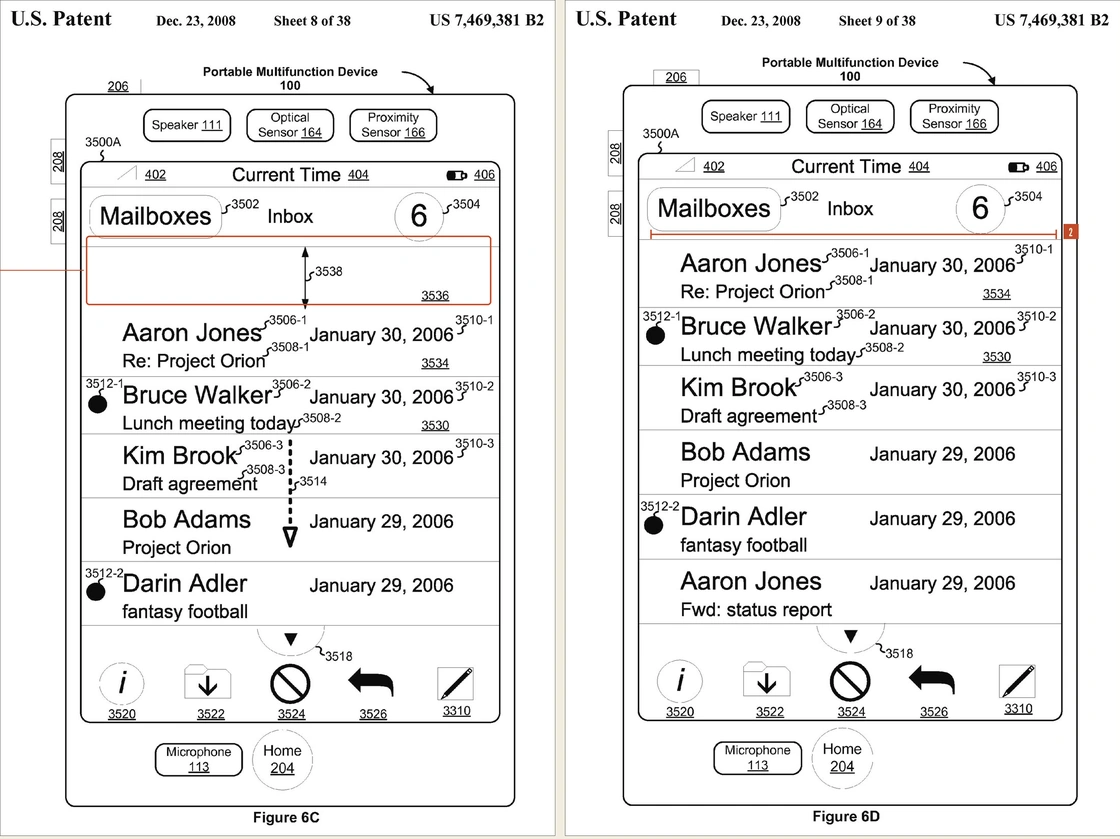
Vitruvius lists them separately, but in my work they never stay apart. The bounce at the end of an iPhone list is math, and Samsung's own testers wrote that it "generates fun for the user."21 The steel holds the Golden Gate Bridge up, but the orange is what people remember, and Irving Morrow picked it partly so ships could see it in the fog.22 Harry Beck's 1933 Tube map threw out real geography for straight lines, and it got easier to use because it got cleaner to look at.23 Each pursuit makes the other two stronger. Combined they make something none of them could make alone.

Two official drawing sheets from Apple’s U.S. Patent 7,469,381: FIG. 6C, the list pulled past its first item with the overscroll band marked in red, and FIG. 6D, the list sprung back, with a red bracket at the vanished gap.
The bounce
  1. 1
    Over the edge. FIG. 6C. The list is pulled past its first item; the blank band is the area beyond the edge.
  2. 2
    Spring-back. FIG. 6D. The finger is lifted; the list is scrolled back until that area is gone.

U.S. Patent 7,469,381 B2, Bas Ording (Apple Inc.), issued 23 December 2008, drawing sheets 8 and 9 of 38, FIGS. 6C and 6D. Public domain (U.S. government publication).

44   TODD HOPKINSON
The Golden Gate Bridge seen from the air, looking south toward San Francisco, in black and white with the painted steel held in International Orange.
The orange is what people remember

International Orange is the only color on the plate. Irving Morrow chose it so the bridge would stand apart from sea and sky, and so ships could see it in the fog.

Carol M. Highsmith, Golden Gate Bridge, San Francisco, California, between 1980 and 2006. Library of Congress, Prints and Photographs Division, LC-DIG-highsm-18066. Public domain.

NOVEMBER 2026   45
A Builder's Lexicon - continued

When Vitruvius defines beauty, he doesn't mean decoration. He means members "in due proportion according to correct principles of symmetry" - the same proportion he finds in the human body two books later.

The circle and the square are Vitruvius's too. He used the figure of a man because he believed nature had proportioned the human body perfectly, and temples should follow the same rules. His chapter on symmetry starts with temples: "The design of a temple depends on symmetry," and a temple's parts need the same precise relation as those "of a well shaped man." Then he measures the human figure. Lay a man on his back with arms and legs spread, he wrote, and a compass centered on his navel will touch his fingers and toes. His height equals his arm span, which makes a square (Book 3, chapter 1).24 Leonardo turned that measurement into a drawing people still hang on walls. The sheet is a study in proportion and a work of art at once.

Disegno

In Vasari's Florence, disegno meant two things at once: the drawing on the page and the plan in the mind. The idea and the hand that draws it shared one word. Painters there belonged to the guild of physicians and apothecaries, because they ground their own colors. In 1563, on Vasari's plan, Duke Cosimo I de' Medici approved an academy for painters, sculptors, and architects, and named it for that word: the Accademia del Disegno.25

Art leads with the eye and the heart. Science leads with the mind. Technology leads with the hand, though the word itself won't let the hand work alone: tekhnē is skill, logos is reason. Design can't lead with any one of them. It needs the eye, the heart, the mind, and the hand at once.26

That's what Vasari saw in Leonardo, who "practised not only this profession but all those in which design played a role."15 Vasari didn't list the professions. He named the thing they shared.

Whatever we call ourselves - artist, engineer, maker - the test is still the one Vitruvius set: make it stand, make it work, make it delight. The words branched out. The trunk is still the work of creating.

END

46   TODD HOPKINSON
A Builder's Lexicon - notes

Notes

  1. 1
    Mark 6:3 reads ho tektōn, "the carpenter, the son of Mary," in all the uncial manuscripts. Some witnesses, including the papyrus P45 (early third century) and family 13, read "the son of the carpenter," matching Matthew 13:55. Luke 4:22 says only "Joseph's son." Bruce Metzger, A Textual Commentary on the Greek New Testament, on Mark 6:3: BibliaPlus.
  2. 2
    Nearly every English Bible says "carpenter" here. The International Standard Version and Sarah Ruden's The Gospels (2021) say "builder," and the Greek allows it. The standard Greek dictionary, Liddell-Scott-Jones, gives tektōn first as a worker in wood, but also as a builder, any craftsman, and a master of an art. Homer uses it for house builders, shipwrights, and a horn-worker. Pindar calls poets tektones of verses. The woodworking picture is old. Around 155–160 AD, Justin Martyr wrote that Jesus made ploughs and yokes.27 Around 384, Jerome's Latin Vulgate used faber, a worker in wood, stone, or metal. The first full English translation of the Gospels, the West Saxon Gospels of about 990, followed the Latin and called him se smiþ, "the smith" - and in Matthew, smiðes sune, "the smith's son."28 "Carpenter" came into English around 1300 from French, out of the Latin carpentarius, a wagon-maker. The Wycliffite Early Version (c. 1382) reads "smyth," following the Vulgate's faber; the Later Version (c. 1395) reads "carpenter."29 Tyndale used it in 1526, and English Bibles kept it. For about four centuries, English called Jesus a smith before it called him a carpenter.
  3. 3
    Old English cræft, "power, physical strength, might," from Proto-Germanic krab-/kraf- (German Kraft, "strength, skill"). The sense widened in Old English to "skill, dexterity; art, science, talent," and by late Old English to "trade, handicraft, employment requiring special skill or dexterity," also "something built or made." The verb cræftan, "to exercise a craft; to build"; "to make skilfully" is from the early 15c., obsolete from the 16c., "revived by 1954, largely in U.S. advertising and commercial senses." Etymonline, craft.
  4. 4
    Latin scientia, "knowledge," from scire, "to know," whose original notion "probably is 'to separate one thing from another, to distinguish,'" related to scindere, "to cut, divide." From c. 1400 also "a skill resulting from training, handicraft; a trade." "Non-arts studies" from the 1670s; "natural and physical science" by the mid-19c. Etymonline, science.
  5. 5
    Whewell's coinage first appeared in print in an unsigned review of Mary Somerville's On the Connexion of the Physical Sciences, Quarterly Review 51 (March 1834): 59, attributed to Whewell: "some ingenious gentleman proposed that, by analogy with artist, they might form scientist" (Internet Archive). The 1840 quotation is from Whewell, The Philosophy of the Inductive Sciences (London, 1840), vol. 1, p. cxiii (Internet Archive). See also Etymonline, scientist, which calls Whewell an "English polymath."
  6. 6
    Old French engin, "skill, wit, cleverness," also "war machine," from Latin ingenium, "innate qualities, ability; inborn character," in Late Latin "a war engine, battering ram"; etymologically "that which is inborn." English from c. 1300. Etymonline, engine.
  7. 7
    Middle English enginour, mid-14c., "constructor of military engines." "Inventor, designer" from the early 15c.; public works from c. 1600, "but was not the common meaning of the word until 19c (hence lingering distinction as civil engineer)." Etymonline, engineer.
  8. 8
    Vitruvius served Julius Caesar as a military engineer, "to supply and repair ballistae, scorpiones, and other artillery," and dedicated De architectura to Augustus, probably between 30 and 20 BC. It is the only architectural treatise to survive from antiquity. Trans. Morris Hicky Morgan (1914), Book 1, preface: Gutenberg.
  9. 9
    Greek poiētēs, "maker, author, poet," from poiein, "to make, create, compose"; "in 16c.-17c. often Englished as maker." Both via Etymonline, poet. George Puttenham, The Arte of English Poesie (1589), Book 1, chapter 1: "A Poet is as much to say as a maker. And our English name well conformes with the Greeke word: for of [poiein] to make, they call a maker Poeta" (Gutenberg).
  10. 10
    Old English wryhta, "worker," a variant of earlier wyhrta, "maker," from wyrcan, "to work"; survives in wheelwright, playwright (1680s), and surnames. Old English leoþ-wyrhta, "professional poet": Etymonline, wright, Etymonline, playwright. leoþ, "song, poem, poetry": St Andrews, Old English Core Vocabulary.
NOVEMBER 2026   47
A Builder's Lexicon - notes

Notes - continued

  1. 11
    "Person of various learning," 1620s, from Greek polymathēs, "having learned much, knowing much," from polys, "much," and the root of manthanein, "to learn" (PIE mendh-, also the source of mathematics). Etymonline, polymath.
  2. 12
    Latin creare, "to make, bring forth, produce, procreate, beget, cause," related to crescere, "arise, be born, increase, grow." De Vaan: "the original meaning of creare 'was "to make grow"'" (via Etymonline, create).
  3. 13
    1670s, "having the quality or function of creating"; of literature and art, "imaginative," from 1816, in Wordsworth; creative writing by 1848. Etymonline, creative.
  4. 14
    Latin designare, "mark out, point out; devise; choose, designate, appoint," from de-, "out," and signare, "to mark," from signum. Italian disegnare in the 16c. "developed the senses 'to contrive, plot, intend,' and 'to draw, paint, embroider, etc.'" OED, quoted there: "in mod.F. dessein is 'purpose, plan', dessin 'design in art'. Eng. on the contrary uses design... in both senses." Etymonline, design.
  5. 15
    "And Leonardo practised not only this profession but all those in which design played a role." Vasari, Lives (1568), trans. J. C. and P. Bondanella (Oxford, 1991). Italian: "non solo esercitò una professione, ma tutte quelle ove il disegno si interveniva" (Wikisource).
  6. 16
    Archivio di Stato di Milano, Autografi, cart. 87, fasc. 1, an undated, anonymous sheet from the 1490s (probably about 1495). The verso reads "Leonardus de Florentia, ingeniarius et pinctor," listed after Bramante, also "ingeniarius et pinctor." The recto lists the ducal engineers separately. Transcription: Archivio di Stato di Milano. Edoardo Villata, Leonardo da Vinci. I documenti e le testimonianze contemporanee (Milan, 1999), p. 87, no. 94. Cesare S. Maffioli, "Leonardo da Vinci et le savoir des ingénieurs," Revue d'histoire des sciences 69/2 (2016): 209ff. (DOI).
  7. 17
    Anonimo Gaddiano (also called the Anonimo Magliabechiano), Florence, Biblioteca Nazionale Centrale, Codice Magliabechiano XVII.17, c. 1540. English from nicofranz.art, which does not name its translator: "Highly gifted in mathematics and no less in the science of perspective, he far surpassed all others in sculpture and drawing… well versed in artillery, aqueducts, and other fantastic inventions."
  8. 18
    Leonardo, Studio di proporzioni del corpo noto come Uomo vitruviano, c. 1490: metalpoint, pen and ink, touches of wash, about 34 × 25 cm. Gallerie dell'Accademia, Venice, cat. 228, kept off display to protect it (museum page). Vitruvius centers both shapes on the navel. Leonardo centers the circle on the navel and the square on the groin. The museum notes that his measurements follow Alberti more closely than Vitruvius.
  9. 19
    Cicero, De Officiis 1.150–151, trans. Walter Miller (Loeb, 1913) (Gutenberg); Latin at The Latin Library. Seneca, Moral Letters to Lucilius 88.21–23, trans. Richard M. Gummere (Loeb, 1917–25) (Wikisource).
  10. 20
    "All these must be built with due reference to durability, convenience, and beauty" - firmitatis, utilitatis, venustatis. Beauty comes "when the appearance of the work is pleasing and in good taste, and when its members are in due proportion according to correct principles of symmetry." Vitruvius 1.3.2, Morgan trans. (Gutenberg); Latin at LacusCurtius. Sir Henry Wotton, The Elements of Architecture (London, 1624), part 1: "Well building hath three Conditions. Commoditie, Firmenes, and Delight." (Internet Archive)
  11. 21
    Apple's U.S. Patent 7,469,381 covers the "rubber band" bounce: scroll past the edge of a document and the page springs back when you let go. Apple credited it to the user interface designer Bas Ording (Fortune, 2012). Samsung's internal usability reports, translated and quoted in an Apple expert report in Apple v. Samsung (N.D. Cal.), said the iPhone's "bouncing" visual effect "generates fun for the user," and faulted Samsung's own tablet for lacking a "Fun, Wow Effect" (court filing, PDF).
  12. 22
    Consulting architect Irving F. Morrow took the idea from the red lead primer on the steel, ran color studies, and rejected black, gray, and aluminum. He chose the orange because it is warm like the land and set apart from the cool sea and sky, and because it is easier for passing ships to see. The U.S. Navy had wanted black and yellow stripes. In his April 1935 Report on Color and Lighting, Morrow wrote, "The effect of International Orange is as highly pleasing as it is unusual in the realm of engineering." Golden Gate Bridge, Highway and Transportation District, Color & Art Deco Styling and Painting the Bridge; National Park Service, Golden Gate Bridge Plaza.
48   TODD HOPKINSON
A Builder's Lexicon - notes

Notes - continued

  1. 23
    Harry Beck, an Underground draughtsman, drew the map in his spare time in 1931, using only horizontal, vertical, and 45-degree lines. London Underground first turned it down as too radical, accepted it in 1932, and issued it as a pocket map in January 1933, in a first run of 750,000 copies. London Museum, "How Harry Beck revolutionised the Tube map"; Alexander J. Kent, "When Topology Trumped Topography: Celebrating 90 Years of Beck's Underground Map," The Cartographic Journal 58, no. 1 (2021): 1–12 (DOI).
  2. 24
    "The design of a temple depends on symmetry, the principles of which must be most carefully observed by the architect… Without symmetry and proportion there can be no principles in the design of any temple; that is, if there is no precise relation between its members, as in the case of those of a well shaped man" (3.1.1). "If a man be placed flat on his back, with his hands and feet extended, and a pair of compasses centred at his navel, the fingers and toes of his two hands and feet will touch the circumference of a circle described therefrom… the breadth will be found to be the same as the height, as in the case of plane surfaces which are perfectly square" (3.1.3). Vitruvius, Book 3, chapter 1, "On Symmetry: In Temples and in the Human Body," Morgan trans. (1914): Gutenberg.
  3. 25
    Accademia delle Arti del Disegno, "Una storia lunga 450 anni" (aadfi.it). Vasari started the plan in May 1562, and Duke Cosimo I's court approved the statutes of the Accademia e Compagnia dell'Arte del Disegno on 13 January 1563. Under the old statutes, painters were enrolled in the Arte dei Medici e degli Speziali because they ground and prepared their colors; sculptors and architects belonged to the Arte dei Maestri di Pietra e di Legname.
  4. 26
    John Ruskin drew a similar line in 1859. Arts such as shipbuilding, he said, are "pursuits in which the hand of man and his head go together." His next sentence: "Then Fine Art is that in which the hand, the head, and the heart of man go together." The Two Paths, Lecture II, "The Unity of Art," an address at Manchester, 14 March 1859; §§53–54 in The Works of John Ruskin, Library Edition, ed. E. T. Cook and Alexander Wedderburn, vol. 16 (London, 1905), p. 294 (Internet Archive). Full text also at Gutenberg.
  5. 27
    Justin Martyr, Dialogue with Trypho 88 (c. 155–160): "He was deemed a carpenter (for He was in the habit of working as a carpenter when among men, making ploughs and yokes; by which He taught the symbols of righteousness and an active life)." Trans. Dods and Reith, Ante-Nicene Fathers 1: New Advent. Justin, a native of Flavia Neapolis (modern Nablus) in Palestine (First Apology 1), who calls the Samaritans "my people" (Dialogue 120, New Advent), is the earliest surviving writer to name what Jesus made. He gives no source.
  6. 28
    Old English smiþ comes from Proto-Germanic smiþaz, "skilled worker." In English it narrowed toward a metalworker, but compounds keep the wider sense: goldsmith, already in Old English, and wordsmith, from 1896. Old Norse smiðr stayed broader, and could mean a worker in metal or wood, or a builder of ships or houses.
  7. 29
    The Wycliffite Bible of about 1382 calls Jesus "smyth" and "the sone of a smyth," glossed "carpenter" (Bradley, Leeds Studies in English 22, 1991, PDF). The later version of about 1395 reads "Whether this is not a carpenter" (Wikisource). Tyndale, Coverdale (1535), Geneva (1560), and the King James Version (1611) all say "carpenter" (KJV 1611).
  8. 30
    Cesare Borgia, letter of patent issued at Pavia, 18 August 1502, naming Leonardo Vinci "our most expert and beloved Family Architect and General Engineer" and commissioning him to survey the fortresses of Borgia's states. Museo Galileo, "Chronology of Leonardo da Vinci" (Museo Galileo).
NOVEMBER 2026   49
50   TODD HOPKINSON
NOVEMBER 2026   51
Oil illustration of a Sky Microduck walking across a picnic blanket toward a 1940s family, painted from the official Pollen Robotics design
NOVEMBER 2026   52
Robot of the Month

Mechanical Ducklings
on the March!

A backyard walk. A Sky Microduck, twenty-five centimeters tall, mid-stride across the picnic blanket toward a family seeing the little fellow for the first time. Painted from Pollen Robotics’ official design.

Art by Todd Hopkinson with Grok, Gemini, and Midjourney

Here is a sight to stop a picnic cold: a little mechanical duck, about the size of a loaf of bread, waddling across the blanket on two legs as if it owned the place.

Its makers call the fellow a Microduck. A robot shop called Pollen Robotics, in Bordeaux, France, built it. They are now the robotics team at Hugging Face. It stands twenty-five centimeters tall, about ten inches, and it weighs under 800 grams, which is less than two pounds. Fifteen motors work the legs, the head, and the neck. A camera looks out from up front. And that beak is no decoration. It is hinged, and it can pick things up. It does not talk. It just makes a few weird little sounds of its own.

As it comes from the shop, the duck already knows its business. It walks, sits, kicks a ball, scoops things up in that beak, and, once you strap on its skates, even roller-skates. If it takes a tumble, it gets back on its feet by itself. You can boss it about with a little hand control before you write a single instruction.

Here is the real stunt. Before a duck ever sets foot on a floor, its makers build a twin of it inside one of those electronic brains, a three-dimensional model with true weight and balance, and set it loose in a make-believe world where a physics engine called MuJoCo works out gravity and friction to the last decimal. Engineers call this a simulation. There the simulated twin practices by trial and error, earning a good mark for every step that works and none for every tumble, until it has the knack. The trade calls this reinforcement learning, and the knack it ends up with, a policy. Then they send that same policy over to the real machine, a jump the engineers call sim-to-real, and the duck checks it fifty times a second as it goes. What the duck learned in that shadow-box, it does on the living-room floor.

It comes in four colors: Cream, Graphite, Lavender, and Sky. The Sky one is the little blue walker in our picture. You may put your name down for one now at $399, and the makers aim to have the first ducks at the door before Christmas.
Sources. Pollen Robotics, “Meet Microduck,” 27 August 2026, and the Microduck product page and press kit, at pollen-robotics.com/microduck/, pollen-robotics.com/microduck/blog/introducing-microduck/, and pollen-robotics.com/microduck/press-kit/. Official Pollen Robotics posts on X, 27 August 2026: x.com/pollenrobotics/status/2092915032052879425, x.com/pollenrobotics/status/2093035817241661639, and x.com/pollenrobotics/status/2092990523522838959.

NOVEMBER 2026   53
In the Shop

Vision   Question
Premise   Decision

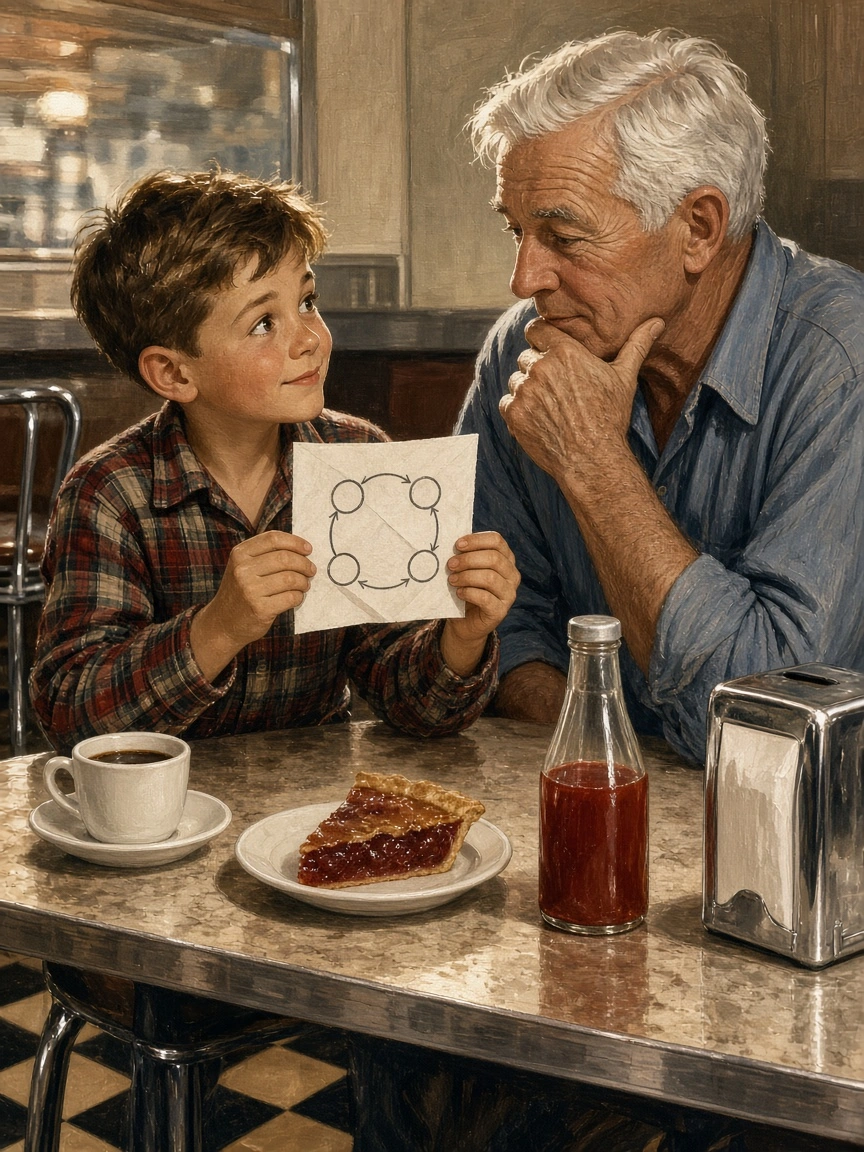
This flywheel starts with a picture.

Every problem worth solving starts as a picture in somebody's head. The trouble is that it's a different picture in every head. Put ten people in a room and you get ten versions of the same problem, and nobody realizes it.

The napkin is the cheapest fix I know. Grab whatever's on the table and draw the problem where everyone can see it. Once it's on paper, everyone is finally talking about the same thing, and nobody has to hold the whole problem in their head while they work through the hard parts. It works for one person thinking alone, too.

That drawing is the first step of a loop I call V-Q-P-D: Vision, Question, Premise, Decision. It's a flywheel, not a checklist. Each step feeds the next, and each lap makes all four clearer. It runs at every scale at once: a whole project, a single meeting, a single step of the loop.

The order matters. A correct decision on a bad premise is still the wrong answer. Get the premise right first, then cut aggressively.

The interactive napkin, with each step worked out in full, lives at toddhopkinson.com/napkin.

A boy of about ten holds up a small paper diner napkin with a four-circle flywheel sketch to his grandfather at a late-1940s diner counter.
  1. 1
  2. 2
  3. 3
  4. 4

THE LOOP KEEPS RUNNING. Each lap clears the vision, the question, the premise, and the decision.

Art by Todd Hopkinson with Grok, Gemini, and Midjourney

  1. 1
    Vision. Draw a picture. Put the essential elements in one place so nobody has to hold the whole thing in their head.
  2. 2
    Question. Develop the golden question. Then ask why, and why again, until you reach the essential truths.
  3. 3
    Premise. Keep what holds up. Throw out the rest. Get the premise wrong and everything built on it is a well-made mistake.
  4. 4
    Decision. Decide for real: cut, change, or polish. Then act on it.