Writing ·
A Builder’s Lexicon
Read it in the November 2026 issue
Art, science, technology, design.
“As everyone knows, words constantly take on new meanings. Since these do not necessarily, nor even usually, obliterate the old ones, we should picture this process not on the analogy of an insect undergoing metamorphoses but rather on that of a tree throwing out new branches, which themselves throw out subordinate branches; in fact, as ramification.”C. S. Lewis, Studies in Words (1960)
Oxford Languages defines technology as “the application of scientific knowledge for practical purposes” (Lexico, archived). The word comes from the Greek tekhnologia, built on tekhnē: art, skill, craft in work, a method of making or doing (Etymonline).
At its root, technology grows out of art and craft. Tekhnē was one Greek word for art, skill, and craft. English split it three ways, into art, craft, and technology. Underneath all three sits one test, written down by a Roman architect more than two thousand years ago: anything built has to stand, work, and delight.
Art Used to Mean Skill
Art went through the same split. When it came into English in the 1200s, it meant any skill learned by study and practice. The sense of “creative arts” shows up around the 1610s, and painting and sculpture in particular around the 1660s (Etymonline). The old meaning never died. It’s still there in liberal arts, state of the art, and the art of war.
Raymond Williams, in Culture and Society, traces how art went from any human skill to a select group of imaginative skills, and how artist, once a skilled person like an artisan, came to mean only those. Larry Shiner, in The Invention of Art, describes the split more sharply and dates it to the eighteenth century: “After over two thousand years of signifying any human activity performed with skill and grace, the concept of art was split apart,” into fine arts on one side and crafts on the other (2001, p. 5).
That’s the tree from C. S. Lewis’s quote above. His trunk is the old meaning of art: any skill learned by practice. The new branch has so outgrown the trunk that most people think art only means the fine arts.
Tekton
Go one step further back. Tekhnē shares a root with tektōn, the Greek word for builder or carpenter. Both words come from an old root meaning “to weave,” and also “to fabricate.” Put arkhi-, “chief,” in front of tektōn and you get arkhitektōn, master builder, which gives us architect (Etymonline). Old English had its own word for an architect: heahcræftiga, “high-crafter.”
The Gospels were written in Greek. Mark calls Jesus ho tektōn, “the builder” (Mark 6:3).1 Matthew calls him tou tektonos huios, “the builder’s son” (Matthew 13:55).2 The translators of the Septuagint had already used tektōn for the Hebrew חָרָשׁ (ḥārāš), a worker in wood, stone, or metal. In 2 Samuel 5:11, Hiram sends craftsmen of wood and of stone, and the Greek calls both tektonas. Isaiah 44:12 uses the same Hebrew word, and the same Greek, for a worker in iron.
Weaver, carpenter, craftsman, artist, architect, technologist - one family, different branches of Lewis’s tree.
Craft
Old English cræft first meant power or strength. During the Old English period it grew to mean skill, art, even science, and by late Old English a trade that takes special skill, or something built or made.3 German Kraft is the same word, and it still means strength. The heahcræftiga, the “high-crafter” from page 37, was a master of this craft.
The verb had a rougher ride. Old English cræftan meant to build. “To make skilfully” shows up in the early 1400s, drops out in the 1500s, and comes back around 1954, mostly in American advertising.3 Every “handcrafted” label on a grocery shelf is using a word that sat unused for about four hundred years.
Science
Science comes through French from Latin scientia, “knowledge,” from scire, “to know.” The Latin verb probably first meant to separate one thing from another, and is related to scindere, “to cut.”4
It started broad in English too. Around 1400 science could mean a skill gained by training, a handicraft, a trade. Using it for everything that isn’t the arts dates from the 1670s. The narrow sense most people mean today, the natural and physical sciences, dates from the mid-1800s.4
The person who does science got a name even later. William Whewell coined scientist in 1834, and he built it on the model of artist. “As an Artist is a Musician, Painter, or Poet,” he wrote in 1840, “a Scientist is a Mathematician, Physicist, or Naturalist.”5 The scientist was named after the artist.
Engineering
Engine comes from Latin ingenium, “innate qualities, ability,” literally what is inborn. In Late Latin it also named a war engine, a battering ram. When it came into English around 1300, engine could mean a machine, and also skill, craft, natural talent, and trickery.6
An engineer, in the mid-1300s, built military engines. The broader sense of inventor or designer came in the early 1400s. Engineers of public works appear around 1600, but that wasn’t the common meaning until the 1800s, which is why we still say civil engineer.7
Vitruvius, the Roman architect, kept Julius Caesar’s artillery working.8 Milan listed the painter Leonardo da Vinci as ingeniarius, an engineer.16 The root of engineer meant a talent in a person before it meant a machine in a field.
Poet and Wright
Poet comes from Greek poiētēs, “maker, author,” from poiein, “to make, create, compose.” In the 1500s and 1600s English often just called a poet a maker. George Puttenham said it plainly in 1589: “A Poet is as much to say as a maker.”9
Old English had its own word for a maker: wyrhta, “worker, maker,” from wyrcan, “to work.” That’s our wright. A wheelwright makes wheels and a playwright makes plays. Old English even had leoþ-wyrhta for a poet, literally a song-wright.10
Pindar called poets tektones of verses, builders.2 Greek and Old English got to the same place on their own. The person who writes a poem and the person who builds a wagon share a job title.
Polymath
Polymath came into English in the 1620s from Greek polymathēs, “having learned much,” from polys, “much,” and the root of manthanein, “to learn.”11 Mathematics grows from the same root.
The word describes what a person learned. Engineer describes what a person does with it: aptitude and experience, put to work. A builder needs both. The label usually goes to Leonardo. Whewell, the man who named the scientist after the artist, gets it too.5
Creative
Create comes from Latin creare, “to make, bring forth, produce,” related to crescere, “to grow.” The Latin etymologist Michiel de Vaan writes that its original meaning was “to make grow.”12
Creative shows up in the 1670s, meaning “having the quality or function of creating.” Its use for literature and art, meaning “imaginative,” dates from 1816, in Wordsworth, and creative writing from 1848.13
Creative went the way of art. It started as any kind of making and narrowed to the arts. When a company calls its designers “the creatives” and treats its engineers as something else, it’s relying on a meaning of creative only about two hundred years new. The older meaning covered anyone who makes things, engineers included.
Design
Design comes from Latin designare, “to mark out, point out, devise,” from de-, “out,” and signare, “to mark,” from signum, a sign.14 In the 1500s the Italian disegnare picked up two meanings at once: to plan or intend, and to draw. French split them into two spellings, dessein for a plan and dessin for a drawing. English kept one word for both.14
Giorgio Vasari, the painter and architect who wrote the Lives of the Renaissance artists (1568), used disegno in a line about Leonardo: “tutte quelle ove il disegno si interveniva,” every profession where design played a role.15 In Italian and in English, the drawing and the intent are the same word.
When someone tells me they’re “not a technical person” or “not an art person,” the language disagrees with them. For most of its history, making a beautiful thing and making a working thing were one skill with one name.
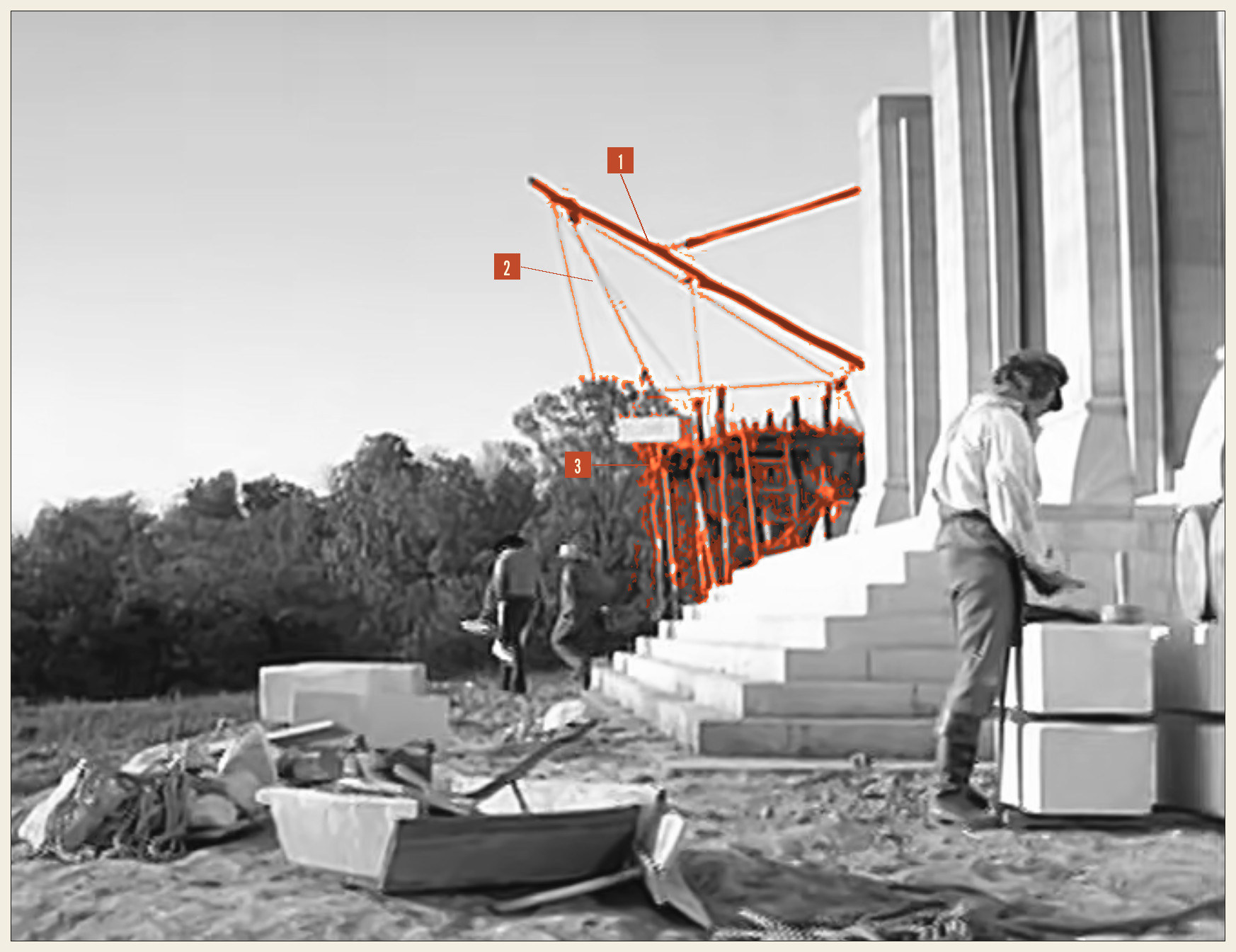
I keep seeing art and engineering turn out to be the same act. When my father, Glen Hopkinson, was painting the storyboards for Legacy, a film by Academy Award–winning director Kieth Merrill, he painted the architectural hoist that one scene called for. Later, on the actual set, it amused Dad to see that the set builders had built a faithful version of his hoisting contraption from the storyboard. A thing of beauty on a storyboard became a thing that actually worked. Dad had engineered the contraption on the spot in paint, being both the engineer and the artist intertwined in one creator.
 (open larger)
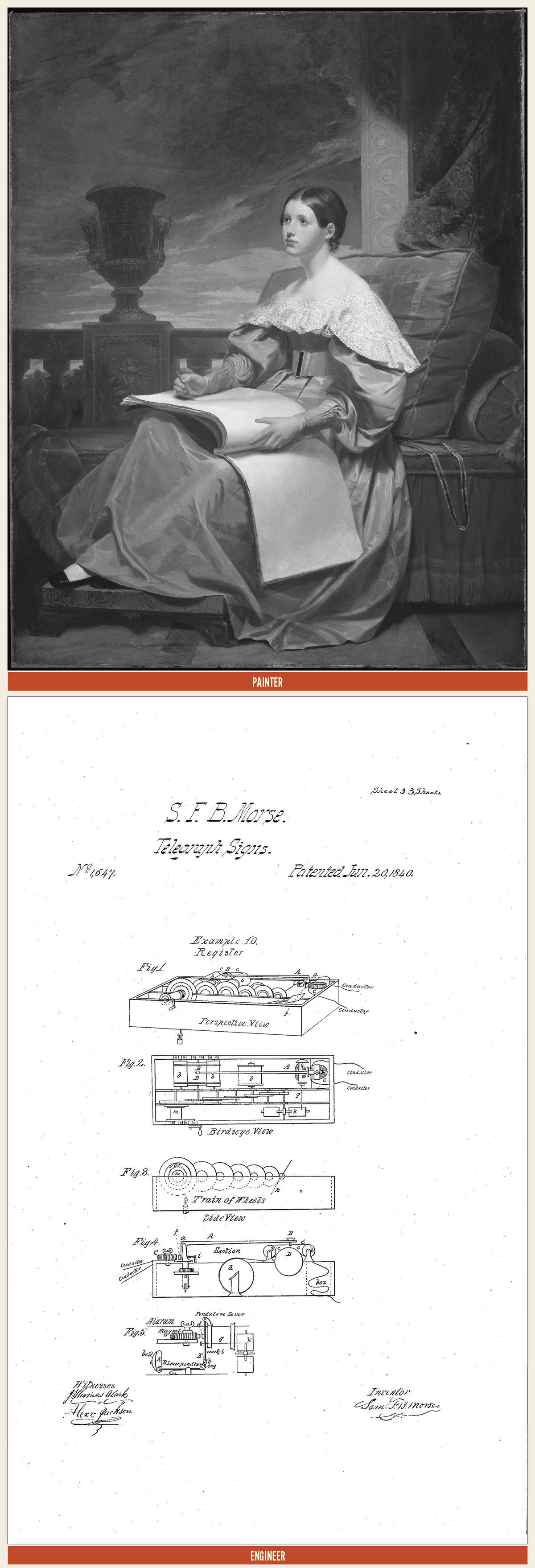
This coupling of art and engineering reminds me of Samuel F. B. Morse, the portrait painter who also co-invented the electric telegraph. And it brings to mind Leonardo da Vinci, whom a Milanese list of engineers from the 1490s calls ingeniarius et pinctor, “engineer and painter.”16 Cesare Borgia named him “Architect and General Engineer.”30
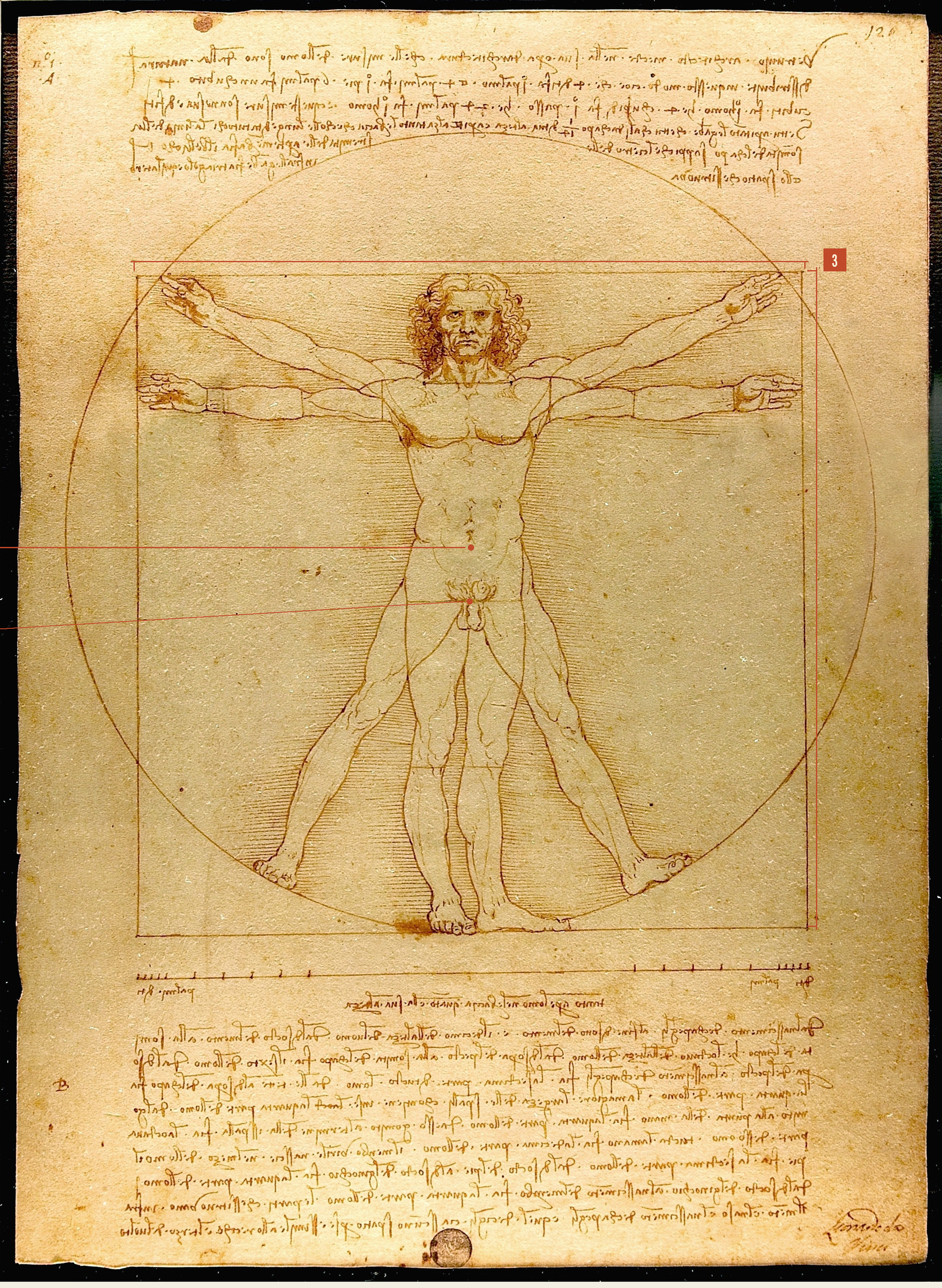
An anonymous biographer, writing a generation after his death, described Leonardo as skilled in mathematics, perspective, sculpture, and the lute, and “well versed in artillery, aqueducts, and other fantastic inventions.”17 He is history’s best-known polymath, and one drawing shows why. Around 1490 he drew a man inside a circle and a square, a figure Vitruvius described.24 We know it as Vitruvian Man.18
 (open larger)
 (open larger)
- 1. Navel. Center of the circle.
- 2. Groin. Center of the square.
- 3. Arm span = height. The square: fingertip to fingertip equals crown to heel.
Leonardo took that figure from a Roman book, and Rome is an odd place to find the ideal of one person who both thinks and makes. Rome split and classified the work of making. In 44 BC, Cicero called the trades of hired hands sordidi, vulgar. “All mechanics are engaged in vulgar trades,” he wrote, “for no workshop can have anything liberal about it” (De Officiis 1.150). He made room for medicine and architecture, but only for men of the right class (1.151). A century later, Seneca reported Posidonius’s four classes of arts. At the bottom sat the common arts, which “belong to workmen and are mere hand-work,” with “no pretence to beauty or honour.” At the top sat the liberal arts, the ones fit for a free man (Letter 88).19 The line between kinds of work ran along the line between kinds of people.
Vitruvius, the architect Leonardo was drawing from, believed the opposite. He wrote that an architect’s knowledge comes from two things: fabrica, practice, the “manual work” done “according to the design of a drawing,” and ratiocinatio, theory, the ability to explain that work by proportion. Architects with only the hand “have never been able to reach a position of authority.” Those with only theory “were obviously hunting the shadow, not the substance.” He wanted both, along with drawing, geometry, history, philosophy, music, medicine, law, and astronomy (De architectura, Book 1, chapter 1). The man who builds had to know nearly everything.
He also gave a three-part test for anything built: it has to stand, it has to work, and it has to delight. Firmitas, utilitas, venustas - durability, convenience, and beauty, in Morgan’s translation (Book 1, chapter 3).20 Sir Henry Wotton put it into English in 1624 as “Commoditie, Firmenes, and Delight.” It’s still the best test I know.
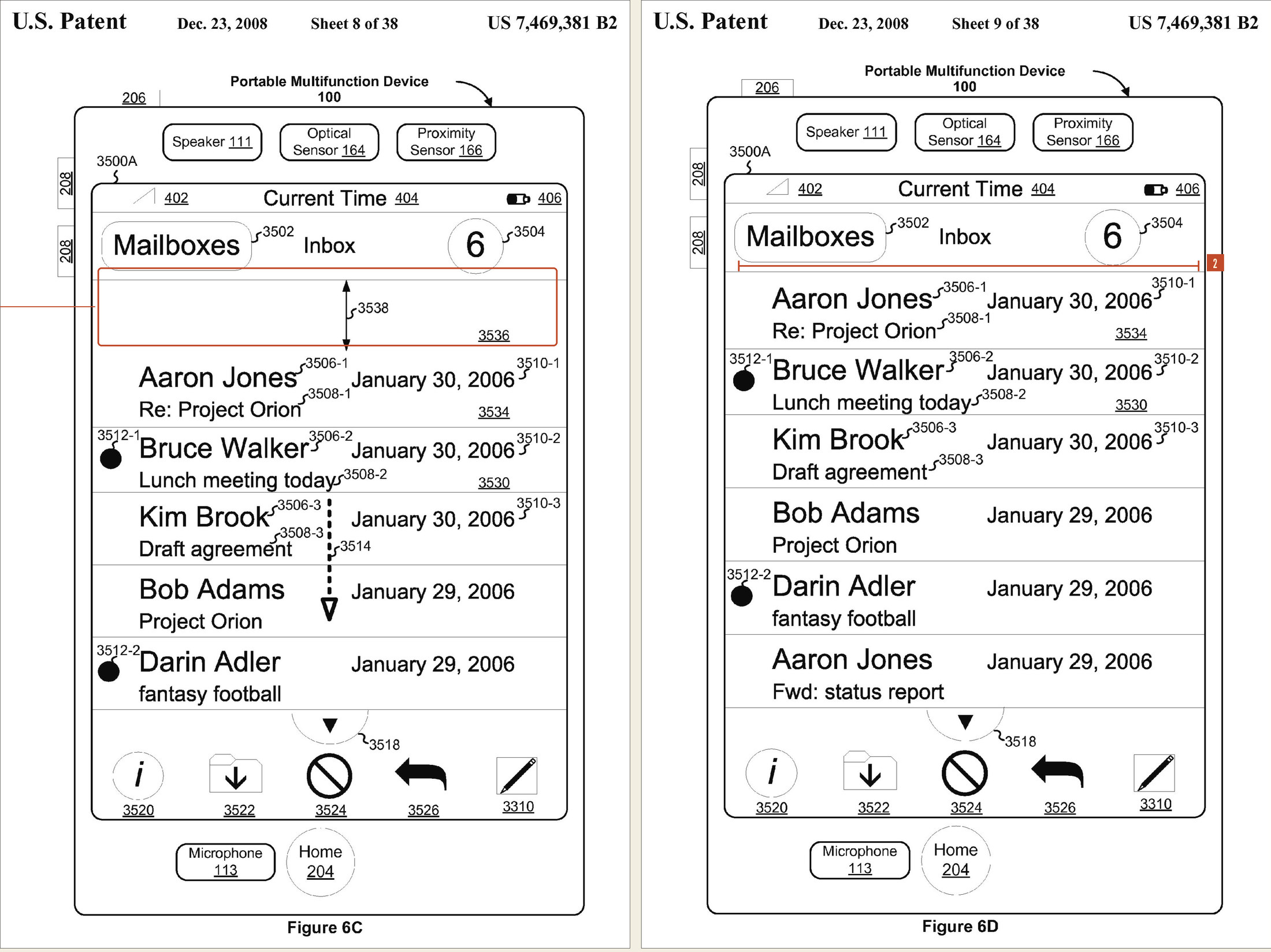
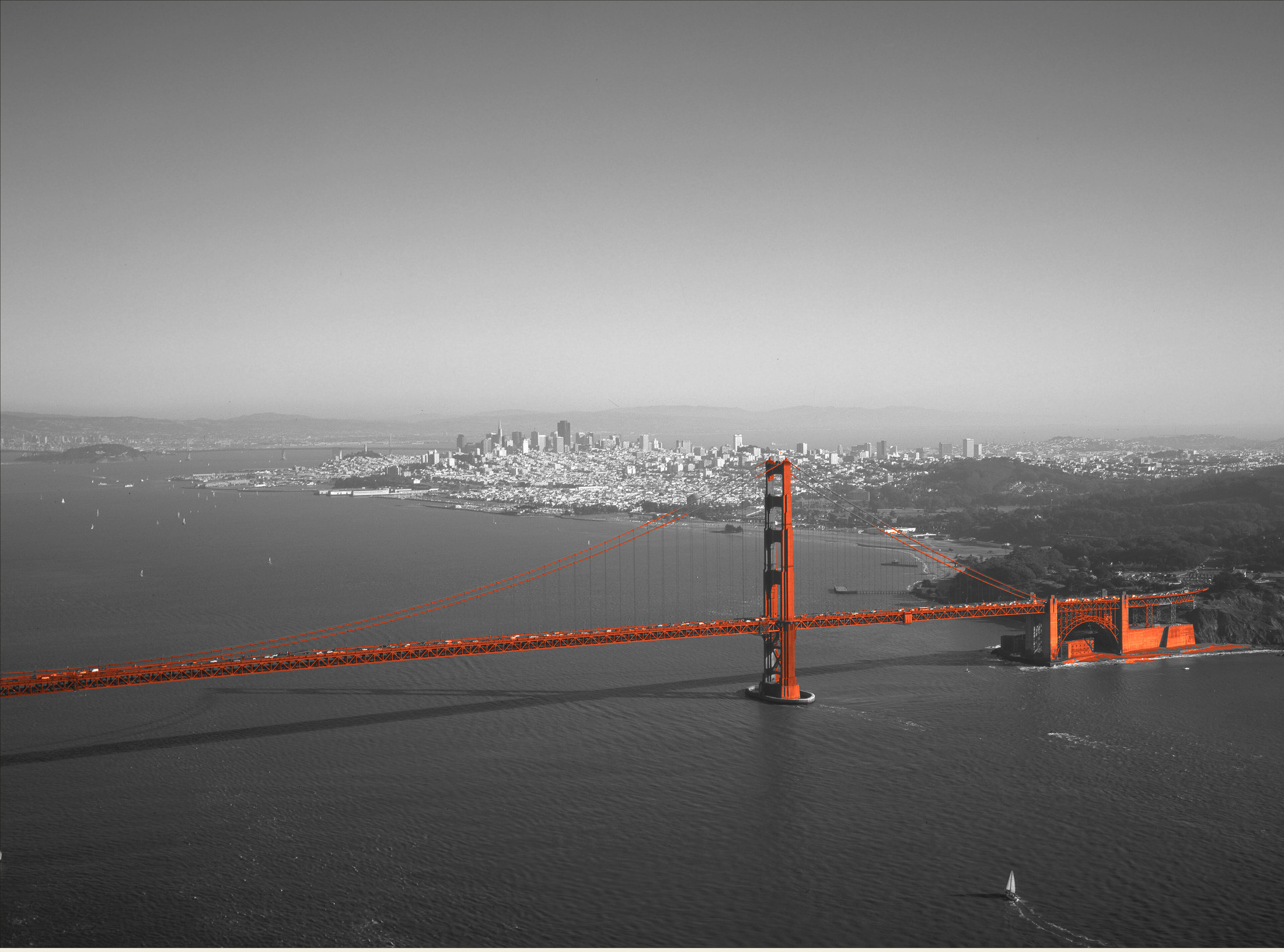
Vitruvius lists them separately, but in my work they never stay apart. The bounce at the end of an iPhone list is math, and Samsung’s own testers wrote that it “generates fun for the user.”21 The steel holds the Golden Gate Bridge up, but the orange is what people remember, and Irving Morrow picked it partly so ships could see it in the fog.22 Harry Beck’s 1933 Tube map threw out real geography for straight lines, and it got easier to use because it got cleaner to look at.23 Each pursuit makes the other two stronger. Combined they make something none of them could make alone.
 (open larger)
 (open larger)
When Vitruvius defines beauty, he doesn’t mean decoration. He means members “in due proportion according to correct principles of symmetry” - the same proportion he finds in the human body two books later.
The circle and the square are Vitruvius’s too. He used the figure of a man because he believed nature had proportioned the human body perfectly, and temples should follow the same rules. His chapter on symmetry starts with temples: “The design of a temple depends on symmetry,” and a temple’s parts need the same precise relation as those “of a well shaped man.” Then he measures the human figure. Lay a man on his back with arms and legs spread, he wrote, and a compass centered on his navel will touch his fingers and toes. His height equals his arm span, which makes a square (Book 3, chapter 1).24 Leonardo turned that measurement into a drawing people still hang on walls. The sheet is a study in proportion and a work of art at once.
Disegno
In Vasari’s Florence, disegno meant two things at once: the drawing on the page and the plan in the mind. The idea and the hand that draws it shared one word. Painters there belonged to the guild of physicians and apothecaries, because they ground their own colors. In 1563, on Vasari’s plan, Duke Cosimo I de’ Medici approved an academy for painters, sculptors, and architects, and named it for that word: the Accademia del Disegno.25
Art leads with the eye and the heart. Science leads with the mind. Technology leads with the hand, though the word itself won’t let the hand work alone: tekhnē is skill, logos is reason. Design can’t lead with any one of them. It needs the eye, the heart, the mind, and the hand at once.26
That’s what Vasari saw in Leonardo, who “practised not only this profession but all those in which design played a role.”15 Vasari didn’t list the professions. He named the thing they shared.
Whatever we call ourselves - artist, engineer, maker - the test is still the one Vitruvius set: make it stand, make it work, make it delight. The words branched out. The trunk is still the work of creating.
Notes
- 1. Mark 6:3 reads ho tektōn, “the carpenter, the son of Mary,” in all the uncial manuscripts. Some witnesses, including the papyrus P45 (early third century) and family 13, read “the son of the carpenter,” matching Matthew 13:55. Luke 4:22 says only “Joseph’s son.” Bruce Metzger, A Textual Commentary on the Greek New Testament, on Mark 6:3: BibliaPlus.
- 2. Nearly every English Bible says “carpenter” here. The International Standard Version and Sarah Ruden’s The Gospels (2021) say “builder,” and the Greek allows it. The standard Greek dictionary, Liddell-Scott-Jones, gives tektōn first as a worker in wood, but also as a builder, any craftsman, and a master of an art. Homer uses it for house builders, shipwrights, and a horn-worker. Pindar calls poets tektones of verses. The woodworking picture is old. Around 155–160 AD, Justin Martyr wrote that Jesus made ploughs and yokes.27 Around 384, Jerome’s Latin Vulgate used faber, a worker in wood, stone, or metal. The first full English translation of the Gospels, the West Saxon Gospels of about 990, followed the Latin and called him se smiþ, “the smith” - and in Matthew, smiðes sune, “the smith’s son.”28 “Carpenter” came into English around 1300 from French, out of the Latin carpentarius, a wagon-maker. The Wycliffite Early Version (c. 1382) reads “smyth,” following the Vulgate’s faber; the Later Version (c. 1395) reads “carpenter.”29 Tyndale used it in 1526, and English Bibles kept it. For about four centuries, English called Jesus a smith before it called him a carpenter.
- 3. Old English cræft, “power, physical strength, might,” from Proto-Germanic krab-/kraf- (German Kraft, “strength, skill”). The sense widened in Old English to “skill, dexterity; art, science, talent,” and by late Old English to “trade, handicraft, employment requiring special skill or dexterity,” also “something built or made.” The verb cræftan, “to exercise a craft; to build”; “to make skilfully” is from the early 15c., obsolete from the 16c., “revived by 1954, largely in U.S. advertising and commercial senses.” Etymonline, craft.
- 4. Latin scientia, “knowledge,” from scire, “to know,” whose original notion “probably is ‘to separate one thing from another, to distinguish,’” related to scindere, “to cut, divide.” From c. 1400 also “a skill resulting from training, handicraft; a trade.” “Non-arts studies” from the 1670s; “natural and physical science” by the mid-19c. Etymonline, science.
- 5. Whewell’s coinage first appeared in print in an unsigned review of Mary Somerville’s On the Connexion of the Physical Sciences, Quarterly Review 51 (March 1834): 59, attributed to Whewell: “some ingenious gentleman proposed that, by analogy with artist, they might form scientist” (Internet Archive). The 1840 quotation is from Whewell, The Philosophy of the Inductive Sciences (London, 1840), vol. 1, p. cxiii (Internet Archive). See also Etymonline, scientist, which calls Whewell an “English polymath.”
- 6. Old French engin, “skill, wit, cleverness,” also “war machine,” from Latin ingenium, “innate qualities, ability; inborn character,” in Late Latin “a war engine, battering ram”; etymologically “that which is inborn.” English from c. 1300. Etymonline, engine.
- 7. Middle English enginour, mid-14c., “constructor of military engines.” “Inventor, designer” from the early 15c.; public works from c. 1600, “but was not the common meaning of the word until 19c (hence lingering distinction as civil engineer).” Etymonline, engineer.
- 8. Vitruvius served Julius Caesar as a military engineer, “to supply and repair ballistae, scorpiones, and other artillery,” and dedicated De architectura to Augustus, probably between 30 and 20 BC. It is the only architectural treatise to survive from antiquity. Trans. Morris Hicky Morgan (1914), Book 1, preface: Gutenberg.
- 9. Greek poiētēs, “maker, author, poet,” from poiein, “to make, create, compose”; “in 16c.-17c. often Englished as maker.” Both via Etymonline, poet. George Puttenham, The Arte of English Poesie (1589), Book 1, chapter 1: “A Poet is as much to say as a maker. And our English name well conformes with the Greeke word: for of [poiein] to make, they call a maker Poeta“ (Gutenberg).
- 10. Old English wryhta, “worker,” a variant of earlier wyhrta, “maker,” from wyrcan, “to work”; survives in wheelwright, playwright (1680s), and surnames. Old English leoþ-wyrhta, “professional poet”: Etymonline, wright, Etymonline, playwright. leoþ, “song, poem, poetry”: St Andrews, Old English Core Vocabulary.
- 11. “Person of various learning,” 1620s, from Greek polymathēs, “having learned much, knowing much,” from polys, “much,” and the root of manthanein, “to learn” (PIE mendh-, also the source of mathematics). Etymonline, polymath.
- 12. Latin creare, “to make, bring forth, produce, procreate, beget, cause,” related to crescere, “arise, be born, increase, grow.” De Vaan: “the original meaning of creare ‘was “to make grow”’” (via Etymonline, create).
- 13. 1670s, “having the quality or function of creating”; of literature and art, “imaginative,” from 1816, in Wordsworth; creative writing by 1848. Etymonline, creative.
- 14. Latin designare, “mark out, point out; devise; choose, designate, appoint,” from de-, “out,” and signare, “to mark,” from signum. Italian disegnare in the 16c. “developed the senses ‘to contrive, plot, intend,’ and ‘to draw, paint, embroider, etc.’” OED, quoted there: “in mod.F. dessein is ‘purpose, plan’, dessin ‘design in art’. Eng. on the contrary uses design… in both senses.” Etymonline, design.
- 15. “And Leonardo practised not only this profession but all those in which design played a role.” Vasari, Lives (1568), trans. J. C. and P. Bondanella (Oxford, 1991). Italian: “non solo esercitò una professione, ma tutte quelle ove il disegno si interveniva” (Wikisource).
- 16. Archivio di Stato di Milano, Autografi, cart. 87, fasc. 1, an undated, anonymous sheet from the 1490s (probably about 1495). The verso reads “Leonardus de Florentia, ingeniarius et pinctor,” listed after Bramante, also “ingeniarius et pinctor.” The recto lists the ducal engineers separately. Transcription: Archivio di Stato di Milano. Edoardo Villata, Leonardo da Vinci. I documenti e le testimonianze contemporanee (Milan, 1999), p. 87, no. 94. Cesare S. Maffioli, “Leonardo da Vinci et le savoir des ingénieurs,” Revue d’histoire des sciences 69/2 (2016): 209ff. (DOI).
- 17. Anonimo Gaddiano (also called the Anonimo Magliabechiano), Florence, Biblioteca Nazionale Centrale, Codice Magliabechiano XVII.17, c. 1540. English from nicofranz.art, which does not name its translator: “Highly gifted in mathematics and no less in the science of perspective, he far surpassed all others in sculpture and drawing… well versed in artillery, aqueducts, and other fantastic inventions.”
- 18. Leonardo, Studio di proporzioni del corpo noto come Uomo vitruviano, c. 1490: metalpoint, pen and ink, touches of wash, about 34 × 25 cm. Gallerie dell’Accademia, Venice, cat. 228, kept off display to protect it (museum page). Vitruvius centers both shapes on the navel. Leonardo centers the circle on the navel and the square on the groin. The museum notes that his measurements follow Alberti more closely than Vitruvius.
- 19. Cicero, De Officiis 1.150–151, trans. Walter Miller (Loeb, 1913) (Gutenberg); Latin at The Latin Library. Seneca, Moral Letters to Lucilius 88.21–23, trans. Richard M. Gummere (Loeb, 1917–25) (Wikisource).
- 20. “All these must be built with due reference to durability, convenience, and beauty” - firmitatis, utilitatis, venustatis. Beauty comes “when the appearance of the work is pleasing and in good taste, and when its members are in due proportion according to correct principles of symmetry.” Vitruvius 1.3.2, Morgan trans. (Gutenberg); Latin at LacusCurtius. Sir Henry Wotton, The Elements of Architecture (London, 1624), part 1: “Well building hath three Conditions. Commoditie, Firmenes, and Delight.” (Internet Archive)
- 21. Apple’s U.S. Patent 7,469,381 covers the “rubber band” bounce: scroll past the edge of a document and the page springs back when you let go. Apple credited it to the user interface designer Bas Ording (Fortune, 2012). Samsung’s internal usability reports, translated and quoted in an Apple expert report in Apple v. Samsung (N.D. Cal.), said the iPhone’s “bouncing” visual effect “generates fun for the user,” and faulted Samsung’s own tablet for lacking a “Fun, Wow Effect” (court filing, PDF).
- 22. Consulting architect Irving F. Morrow took the idea from the red lead primer on the steel, ran color studies, and rejected black, gray, and aluminum. He chose the orange because it is warm like the land and set apart from the cool sea and sky, and because it is easier for passing ships to see. The U.S. Navy had wanted black and yellow stripes. In his April 1935 Report on Color and Lighting, Morrow wrote, “The effect of International Orange is as highly pleasing as it is unusual in the realm of engineering.” Golden Gate Bridge, Highway and Transportation District, Color & Art Deco Styling and Painting the Bridge; National Park Service, Golden Gate Bridge Plaza.
- 23. Harry Beck, an Underground draughtsman, drew the map in his spare time in 1931, using only horizontal, vertical, and 45-degree lines. London Underground first turned it down as too radical, accepted it in 1932, and issued it as a pocket map in January 1933, in a first run of 750,000 copies. London Museum, “How Harry Beck revolutionised the Tube map”; Alexander J. Kent, “When Topology Trumped Topography: Celebrating 90 Years of Beck’s Underground Map,” The Cartographic Journal 58, no. 1 (2021): 1–12 (DOI).
- 24. “The design of a temple depends on symmetry, the principles of which must be most carefully observed by the architect… Without symmetry and proportion there can be no principles in the design of any temple; that is, if there is no precise relation between its members, as in the case of those of a well shaped man” (3.1.1). “If a man be placed flat on his back, with his hands and feet extended, and a pair of compasses centred at his navel, the fingers and toes of his two hands and feet will touch the circumference of a circle described therefrom… the breadth will be found to be the same as the height, as in the case of plane surfaces which are perfectly square” (3.1.3). Vitruvius, Book 3, chapter 1, “On Symmetry: In Temples and in the Human Body,” Morgan trans. (1914): Gutenberg.
- 25. Accademia delle Arti del Disegno, “Una storia lunga 450 anni” (aadfi.it). Vasari started the plan in May 1562, and Duke Cosimo I’s court approved the statutes of the Accademia e Compagnia dell’Arte del Disegno on 13 January 1563. Under the old statutes, painters were enrolled in the Arte dei Medici e degli Speziali because they ground and prepared their colors; sculptors and architects belonged to the Arte dei Maestri di Pietra e di Legname.
- 26. John Ruskin drew a similar line in 1859. Arts such as shipbuilding, he said, are “pursuits in which the hand of man and his head go together.” His next sentence: “Then Fine Art is that in which the hand, the head, and the heart of man go together.” The Two Paths, Lecture II, “The Unity of Art,” an address at Manchester, 14 March 1859; §§53–54 in The Works of John Ruskin, Library Edition, ed. E. T. Cook and Alexander Wedderburn, vol. 16 (London, 1905), p. 294 (Internet Archive). Full text also at Gutenberg.
- 27. Justin Martyr, Dialogue with Trypho 88 (c. 155–160): “He was deemed a carpenter (for He was in the habit of working as a carpenter when among men, making ploughs and yokes; by which He taught the symbols of righteousness and an active life).” Trans. Dods and Reith, Ante-Nicene Fathers 1: New Advent. Justin, a native of Flavia Neapolis (modern Nablus) in Palestine (First Apology 1), who calls the Samaritans “my people” (Dialogue 120, New Advent), is the earliest surviving writer to name what Jesus made. He gives no source.
- 28. Old English smiþ comes from Proto-Germanic smiþaz, “skilled worker.” In English it narrowed toward a metalworker, but compounds keep the wider sense: goldsmith, already in Old English, and wordsmith, from 1896. Old Norse smiðr stayed broader, and could mean a worker in metal or wood, or a builder of ships or houses.
- 29. The Wycliffite Bible of about 1382 calls Jesus “smyth” and “the sone of a smyth,” glossed “carpenter” (Bradley, Leeds Studies in English 22, 1991, PDF). The later version of about 1395 reads “Whether this is not a carpenter” (Wikisource). Tyndale, Coverdale (1535), Geneva (1560), and the King James Version (1611) all say “carpenter” (KJV 1611).
- 30. Cesare Borgia, letter of patent issued at Pavia, 18 August 1502, naming Leonardo Vinci “our most expert and beloved Family Architect and General Engineer” and commissioning him to survey the fortresses of Borgia’s states. Museo Galileo, “Chronology of Leonardo da Vinci” (Museo Galileo).