Writing · Cover Story ·
The Best Part Is No Part
Read it in the November 2026 issue
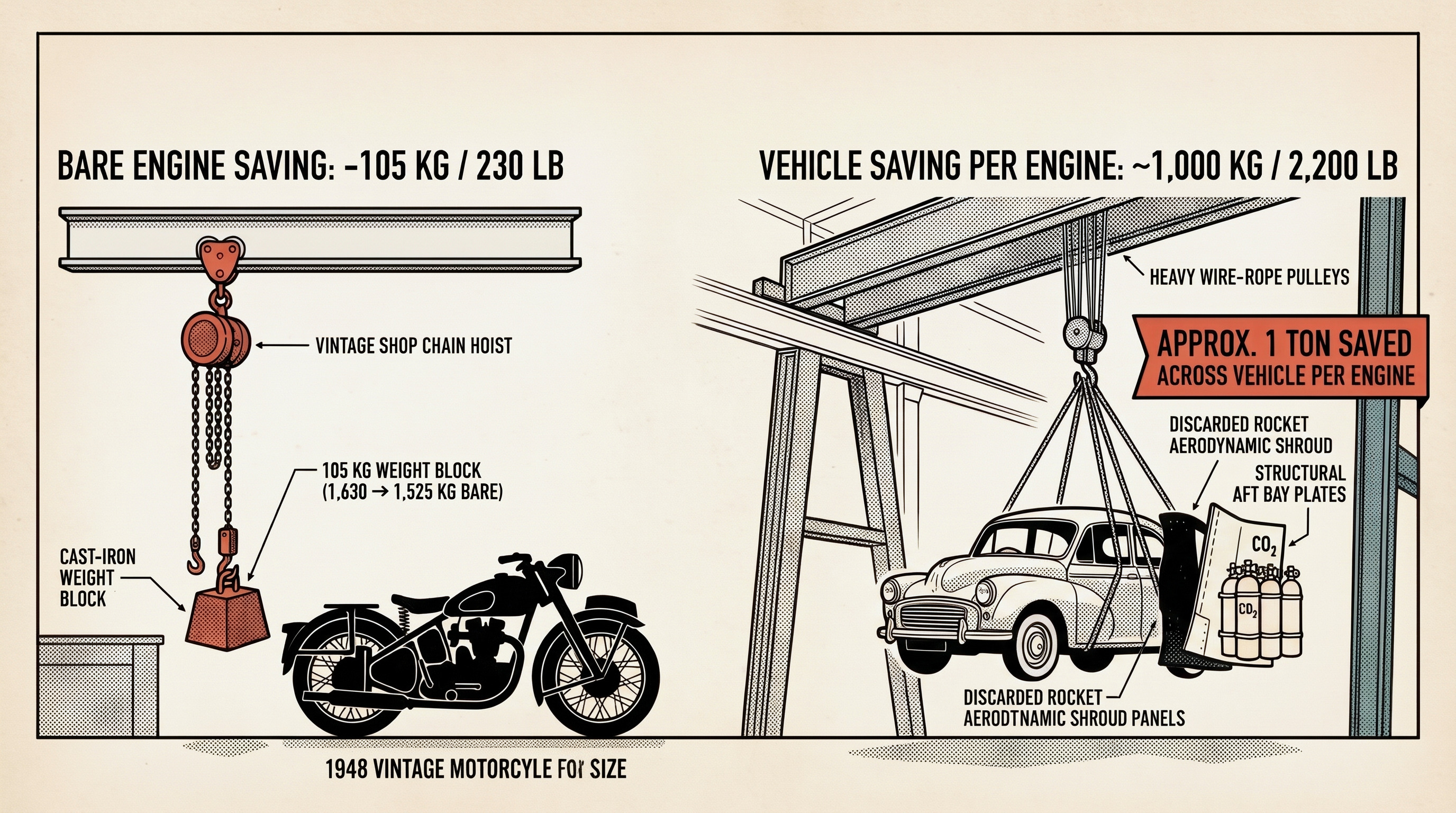
SpaceX stripped its Raptor engine bare. The engine lost about 105 kilograms. The rocket saved about a ton per engine.
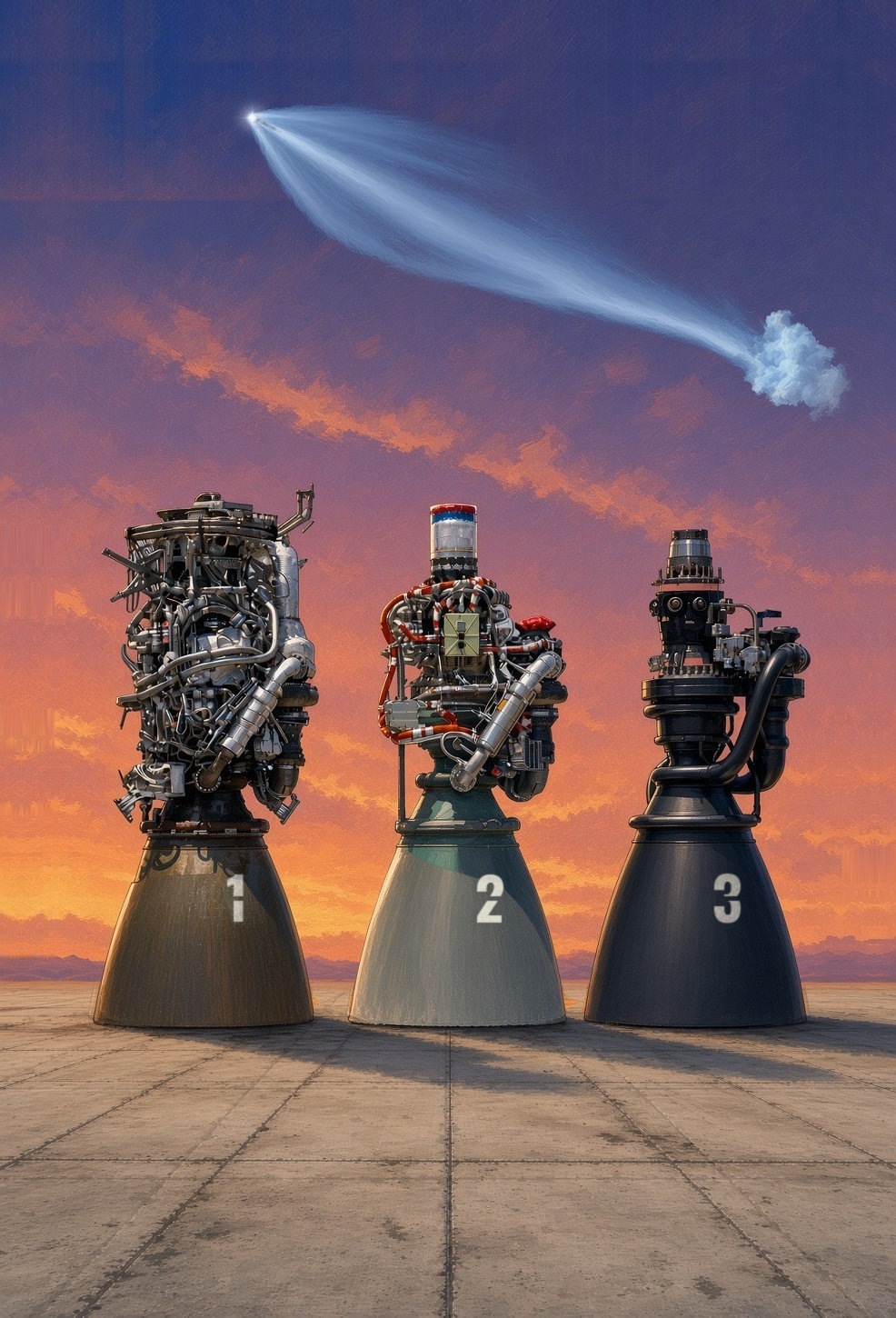
Raptor is the engine behind Starship, SpaceX’s rocket built to fly into space, return, and fly again in short order. On the vehicles flying now, 39 Raptors do the lifting: 33 under the booster and 6 on the ship. Across three versions, SpaceX has raised the engine’s thrust by 35 to 40 percent - to 250 tonnes on Raptor 3 - while cutting its weight by about a quarter.
But Raptor 3’s biggest saving didn’t show up on the engine at all.
Raptor 2 weighed 1,630 kilograms bare. Raptor 3 weighs 1,525. That’s 105 kilograms (about 230 pounds) lighter, or about 6 percent of the engine. Take 230 pounds off an engine and you’d expect the rocket to get 230 pounds lighter. Instead, SpaceX says the savings across the whole vehicle “reach approximately 1 ton per engine” - about 1,000 kilograms (2,200 pounds), roughly the weight of a small car and nearly ten times what the engine itself lost.
 (open larger)
 (open larger)
Stripped to Bare Metal
 (open larger)
Most of that saving came from equipment around the engine, not from the engine itself.
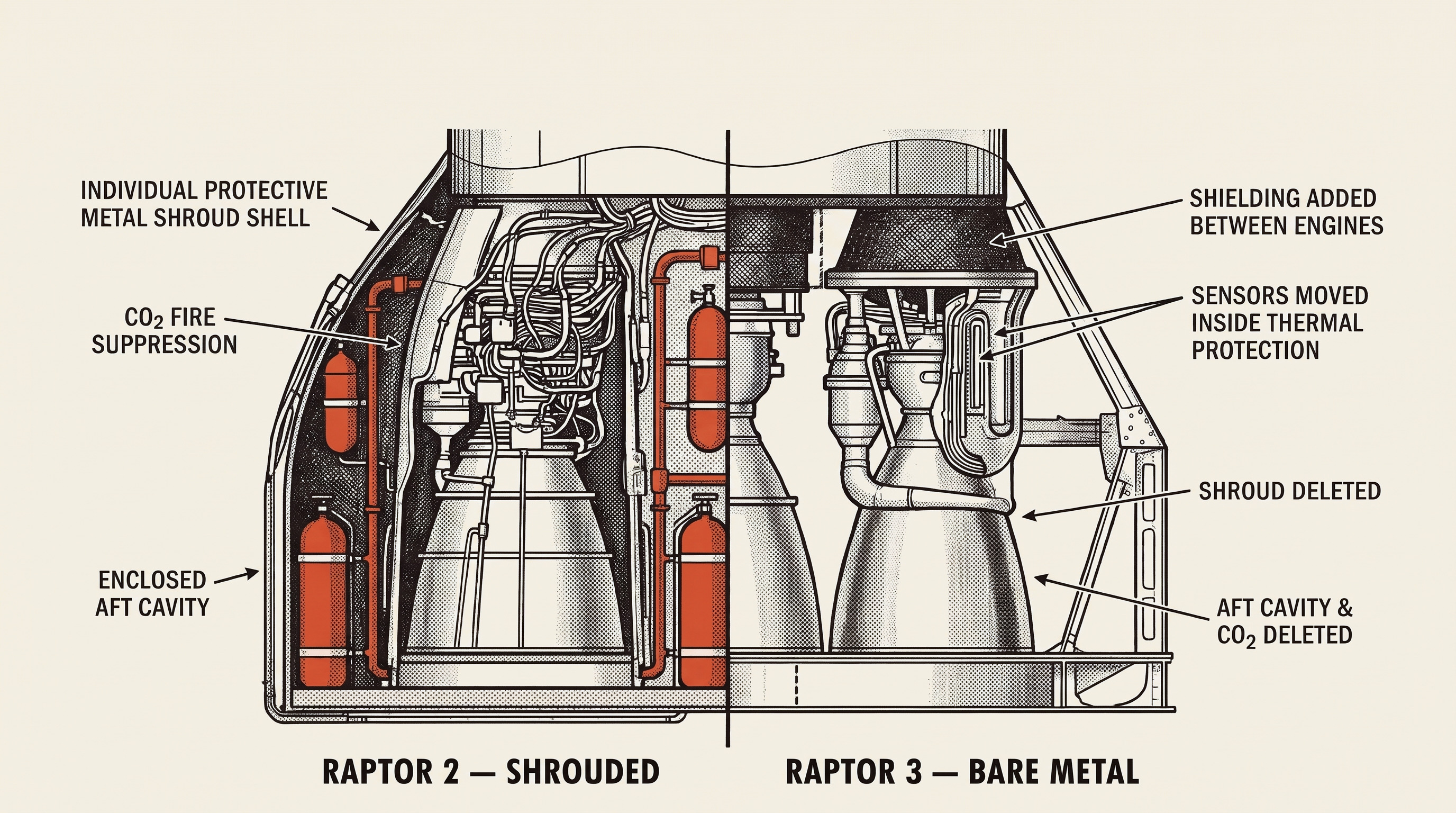
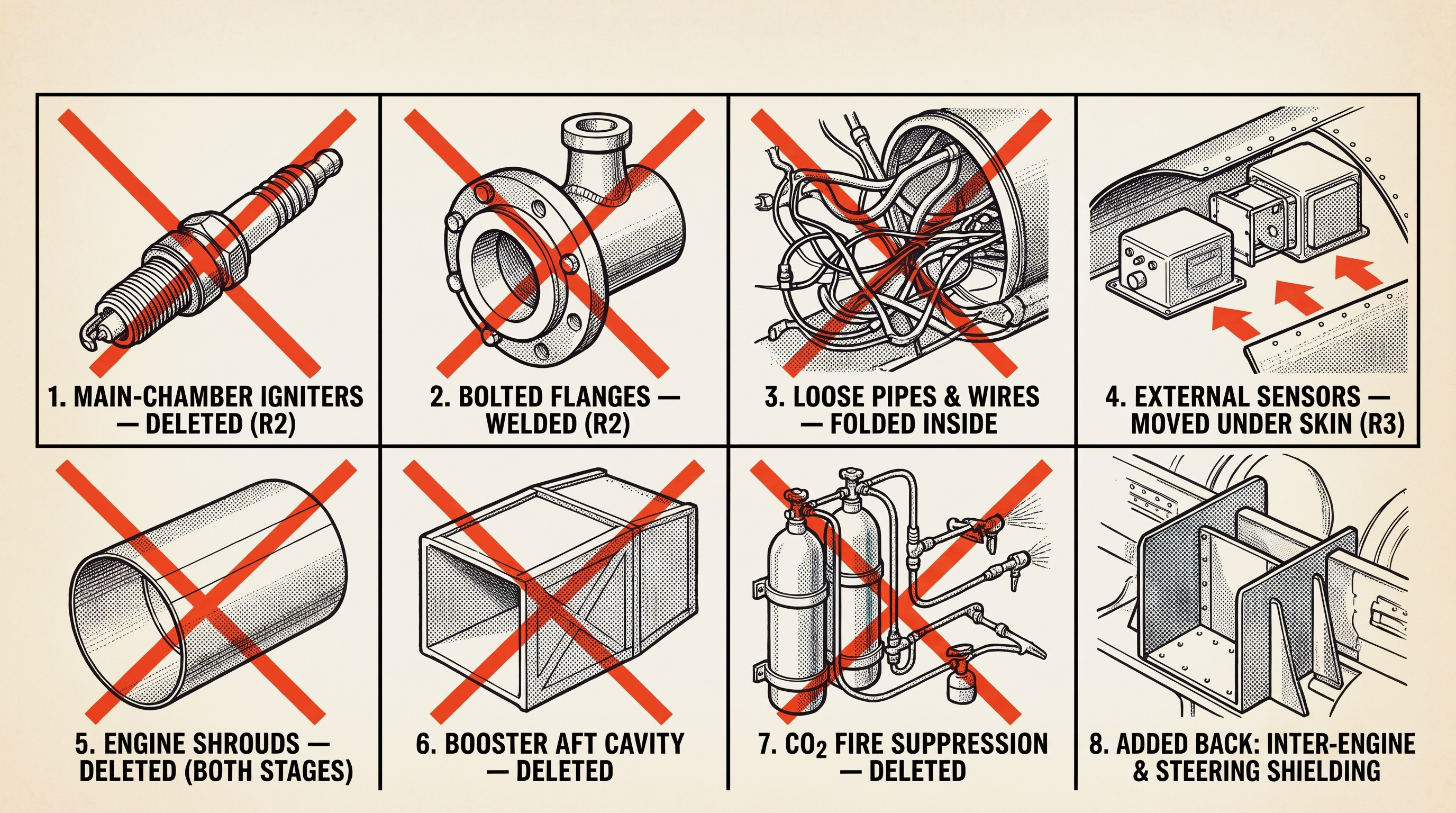
Put Raptor 3 next to Raptor 2 and the new one looks like somebody forgot to finish building it. Where earlier engines wore a tangle of small pipes, wires, and sensors - or hid them inside a protective cover called a shroud - Raptor 3 is smooth, bare metal. SpaceX tucked the sensors and controllers inside, under the engine’s own thermal protection, and deleted the individual engine shrouds on both stages.
Bare doesn’t mean unprotected. The engine still carries its own thermal protection, and the booster added shielding between its engines.
Start from the Physics
“The best part is no part, the best process is no process.” Elon Musk said that at a Starship presentation on September 28, 2019. He was talking about how SpaceX works in general. SpaceX wouldn’t show Raptor 3 for almost five more years.
The idea underneath is older still. In a 2012 interview he described first principles as a way to “boil things down to the most fundamental truths” and “then reason up from there.” His example was batteries, not rockets. Start from the physics, then ask what the part really has to be.
Cut First, Polish Later
In a 2021 interview, Musk gave a five-step order of operations: question the requirement, delete the part or process, simplify, speed up, automate. On step two, his words were “try very hard to delete the part or process.”
The order matters. Deleting is step two. Making a thing better is step three. In a 2022 interview, standing next to Raptor hardware, he gave the reason: “possibly the single biggest mistake made by smart engineers is optimizing a thing that should not exist.”
If you polish a part first, you may have spent your best hours on something you were about to throw away.
HOW IT WORKS: Nothing Goes Overboard
 (open larger)
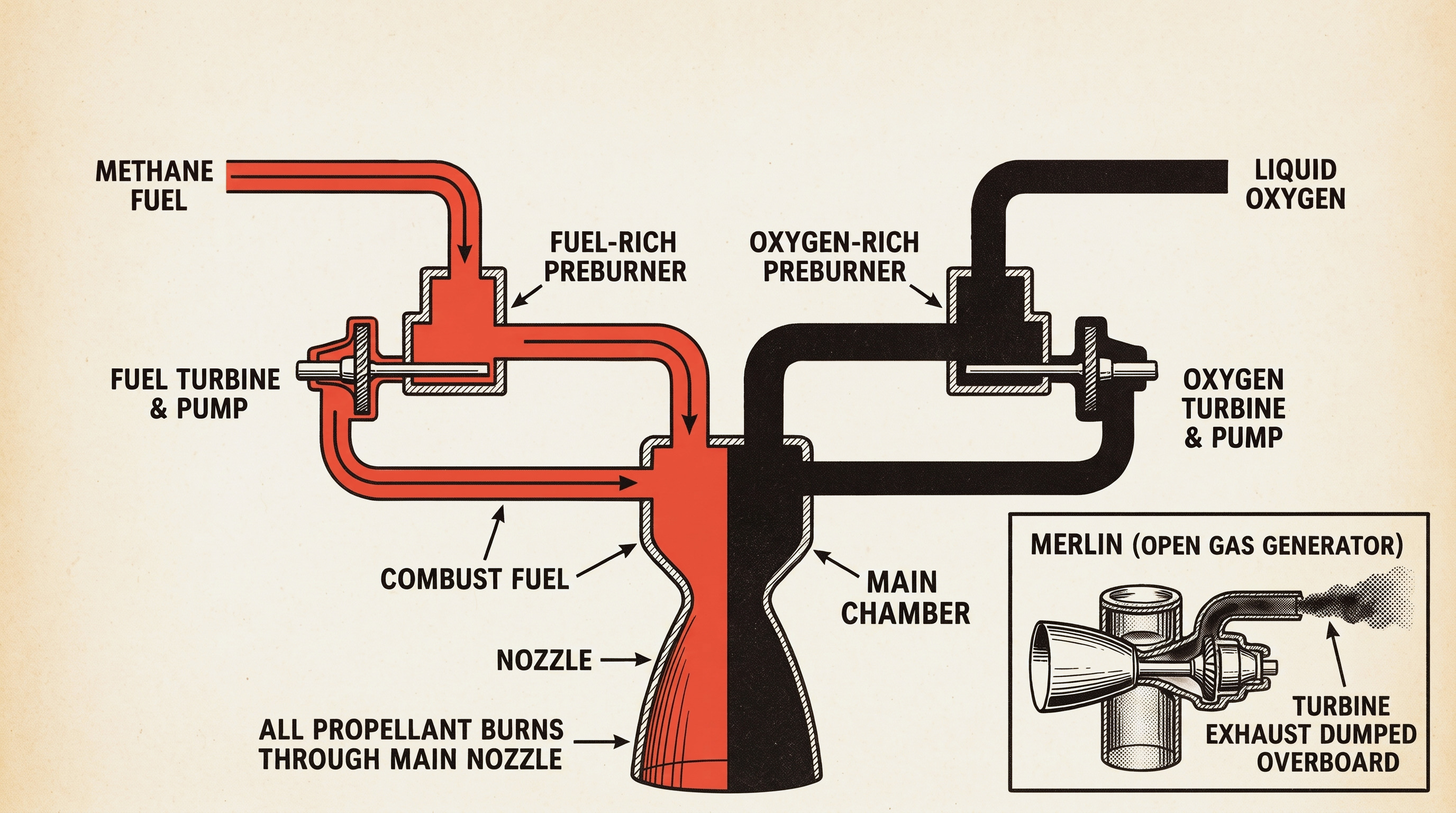
Raptor burns liquid methane and liquid oxygen. Both are cryogenic, which means they’re stored as very cold liquids.
- A small burner called a preburner runs rich in fuel. Its hot gas spins the turbine that drives the fuel pump.
- A second preburner runs rich in oxygen. Its hot gas spins the turbine that drives the oxygen pump.
- Both hot streams flow into the main chamber, finish burning there, and push out through the nozzle.
Nothing gets dumped overboard. Merlin, the engine on Falcon 9, uses a gas-generator cycle, an open cycle that throws its turbine exhaust away. The price of full flow is a harder start, because the two streams depend on each other.
Why methane? It sits between hydrogen’s efficiency and kerosene’s density. It leaves less coking (carbon buildup) than kerosene. And it may be possible to make it on Mars.
SpaceX didn’t invent the cycle. The Soviet RD-270 and the US Integrated Powerhead Demonstrator came first, and neither flew. Raptor was the first to fly it.
THE RAPTOR LOG: Twelve Years, Three Engines
- April 2014. NASA and SpaceX start testing Raptor components at Stennis Space Center in Mississippi.
- January 2016. The Air Force and SpaceX agree to share the cost of a Raptor prototype: about $34 million from the Air Force, about $67 million from SpaceX.
- August 27, 2019. Starhopper, a test vehicle with a single Raptor, hops 150 meters.
- September 28, 2019. Musk says, “The best part is no part.”
- 2022. Raptor 2 runs at 230 tonnes of thrust, with parts “deleted, combined, simplified.”
- August 2024. SpaceX shows Raptor 3.
- October 13, 2024. The launch tower catches a returning booster for the first time.
- November 19, 2024. A Raptor relights in space for the first time.
- October 2025. SpaceX reports more than 600 Raptors built.
- May 22, 2026. Raptor 3 flies for the first time.
- September 28, 2026. Starship reaches orbit for the first time.
- October 2026. A Raptor 4 target of 300 tonnes is reported.
Fewer Bolts, Fewer Leaks
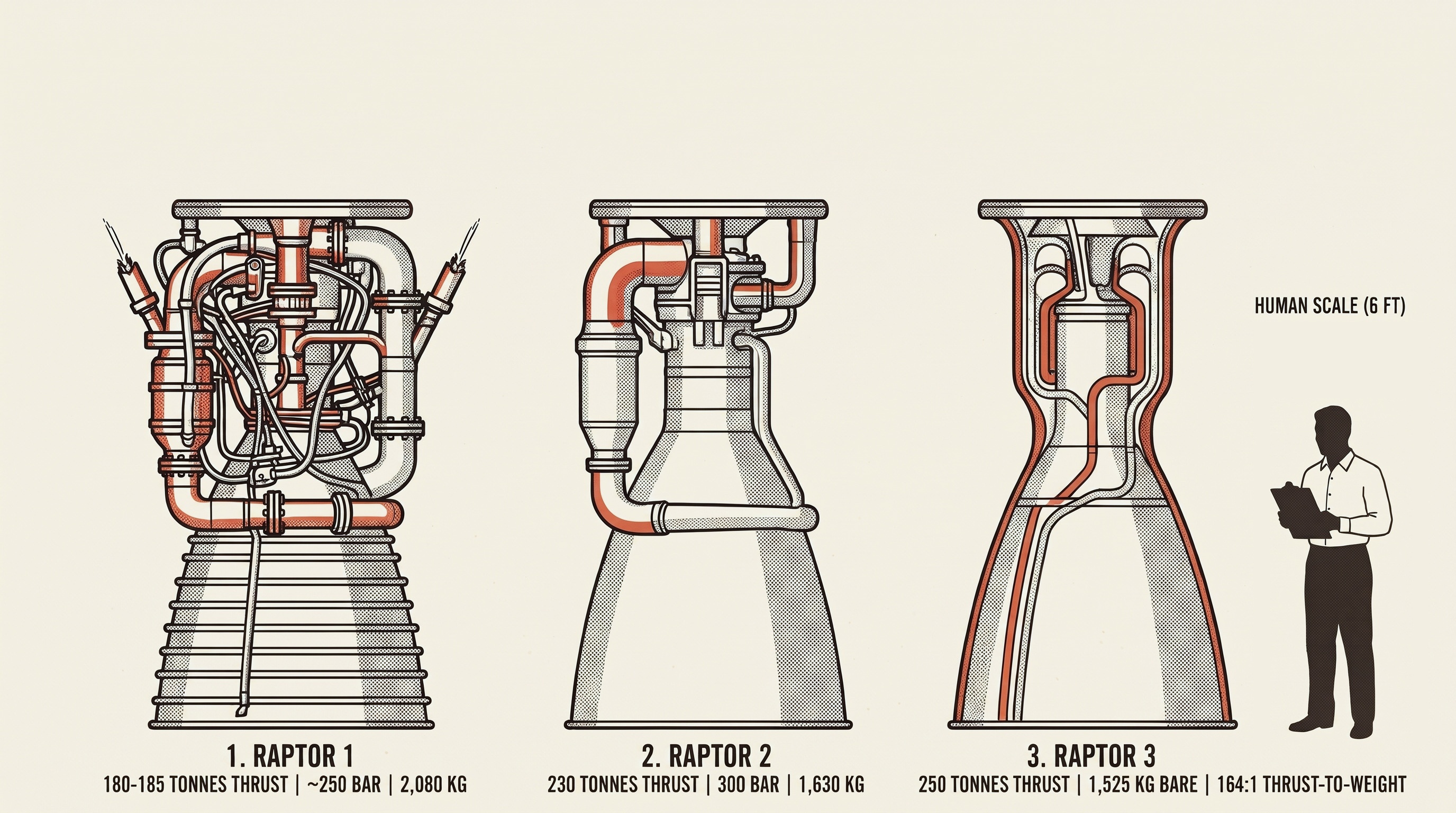
Raptor 1 made about 180 to 185 tonnes of thrust at roughly 250 bar. Raptor 2 made 230 tonnes at 300 bar. A tonne of thrust is the force it takes to hold up one metric ton against Earth’s gravity. A bar is close to the air pressure at sea level. So 300 bar is about 4,350 psi, or about 124 times the pressure in a car tire set to 35 psi. It’s roughly the water pressure 3 kilometers down in the ocean.
Raptor 2 was also lighter: 1,630 kilograms, against 2,080 reported for Raptor 1. That’s about 450 kilograms gone in one generation. Raptor 3 took off another 105 and added 20 tonnes of thrust. A bare Raptor 3 now produces about 164 times its own weight in thrust. That’s like a 70-kilogram person holding up 11.5 tonnes. It produces nearly three times the thrust of the sea-level Merlin engine on a Falcon 9.
“Sea-level” names the nozzle, not the altitude. The best nozzle shape depends on the air pushing back. Near the ground a sea-level engine needs a short bell, because a very wide one lets the exhaust pull away from its walls and shake the engine. In space there is no air, so a vacuum engine gets a long, wide bell that squeezes out more thrust. A sea-level Raptor can still fire in space; it just gives up some efficiency.
 (open larger)
Musk described how it got there: “a massive amount of things have been deleted… deleted, combined, simplified, on Raptor 2 versus Raptor 1.” The torch igniters on the main chamber came off, and the preburners kept simpler torch igniters. Musk wouldn’t say how the main chamber lights now. He called it “secret sauce.” Valves merged into single parts. Bolted joints gave way to welds.
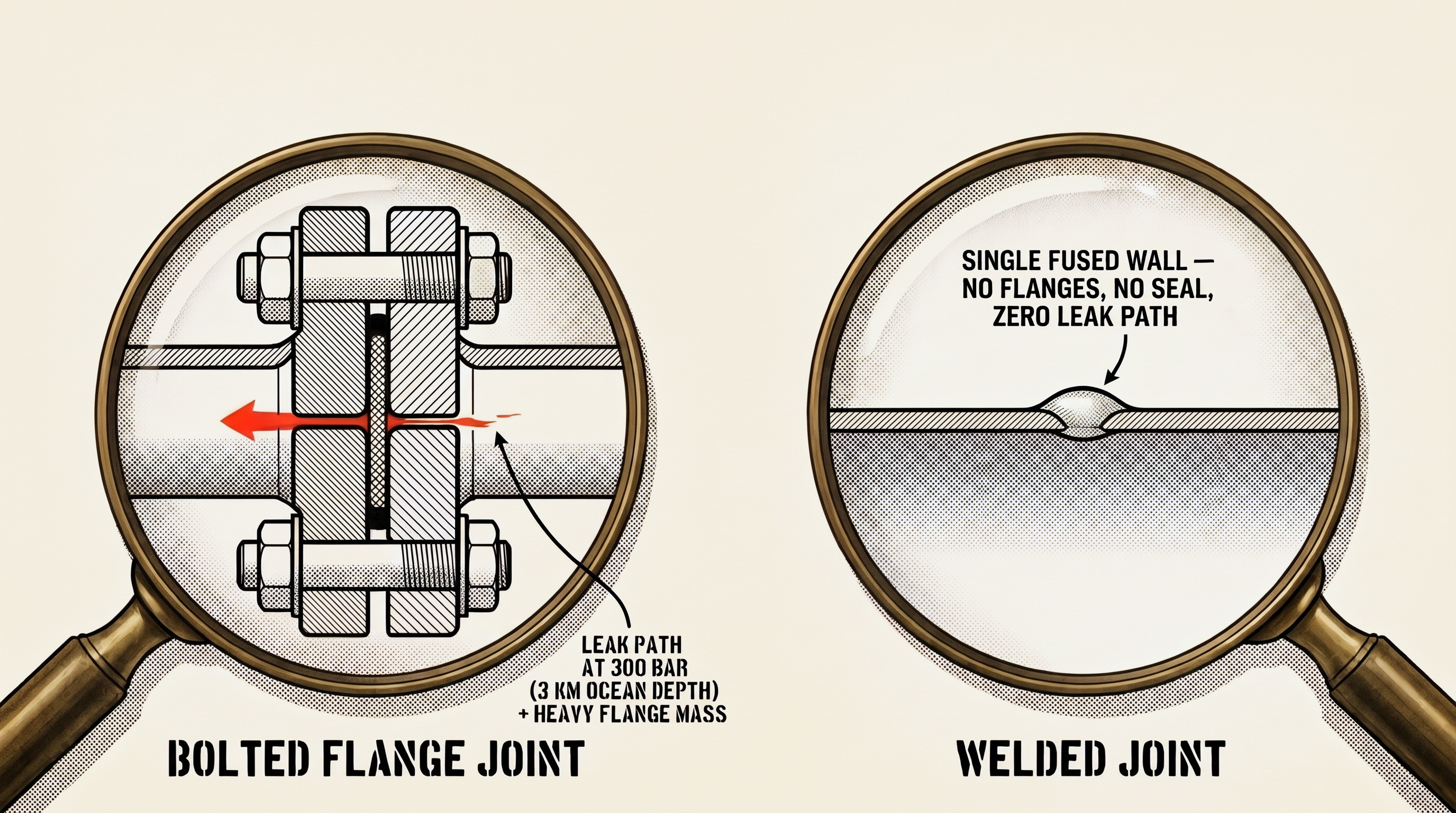
Joints matter because “every interface there has some leak rate that is above zero.” A bolted joint needs heavy flanges, bolts, and a seal, and it has to hold everything from cryogenic liquid to hot oxygen-rich gas. A weld cuts the weight and a leak path in one move.
 (open larger)
His priority in 2022 was explicit: “Right now, we’re optimizing Raptor 2 for robustness, as opposed to performance.” Next on his list was deleting more of the small loose parts and folding the pipes and wiring in far enough to get rid of the shrouds. He also named the catch: “if there’s any part of the engine that is susceptible to heat, then we cannot delete the shroud.”
The Shroud Took Its Plumbing With It
By May 2026 the shrouds were gone. Follow the chain.
A shroud exists to protect parts that can’t take heat. Move the sensors and controllers under the engine’s thermal protection, and the shroud has no job. Delete the shroud, and the booster no longer needs the enclosed cavity around its engines. Delete the cavity, and it no longer needs the CO₂ fire-suppression system that protected it. On the ship, SpaceX rerouted the fluid and electrical lines at the back and deleted the large closed-off space there.
SpaceX was already counting the engine and its surroundings together in 2024. Its announcement listed the engine at 1,525 kilograms and 1,720 kilograms with the vehicle-side fluids and hardware it needs.
The back of the ship had already caused trouble. After Flight 7 in 2025, SpaceX traced the ship’s loss partly to leaks and fires in an aft compartment it calls the “attic,” and said Raptor 3 would mean “eliminating the majority of joints that can leak into this volume.”
The first iPhone made the same move. In 2007 the smartphones to beat, the BlackBerry and the Treo, carried a little plastic keyboard on the bottom half of their faces. Apple left it off, and the keys, the housing, and the half of the phone they filled went with it. The keyboard became software, so it showed up when you typed and got out of the way when you didn’t. Steve Jobs put it plainly that June: you can “remove the keyboard when it’s not needed, freeing iPhone’s entire large screen.” The whole face of the phone became screen.
Subtraction had a cost, and SpaceX says so. The booster gained shielding between engines and around the thrust-vector-control hardware, the gear that swivels the engines to steer. SpaceX redesigned the ignition system on every variant instead of removing it. Deleting a part moved some of the work. It didn’t make all of it disappear.
 (open larger)
Printed, Not Bolted Together
Many of Raptor 3’s pipes went inside the engine’s own walls, and 3D printing is a big part of how. Metal 3D printing builds a part from fine metal powder, one thin layer at a time, with a laser melting each layer onto the last. Because the part grows from nothing, it can have hollow channels inside it, and one printed piece can replace an assembly of several joined parts.
SpaceX leaned heavily on it for Raptor 3, Aviation Week reported, to fold plumbing and wiring that once hung on the outside into the engine’s metal structure. Musk has said SpaceX has “the most advanced 3D metal printing technology in the world.”
Jeff Thornburg, who ran propulsion at SpaceX, told 3DPrint.com that using additive manufacturing was “almost a foregone conclusion”: “Elon wanted an engine in less than five years - and we had one on the stand in four. Additive made that possible.”
How much is printed? SpaceX hasn’t said, and no one outside the company has taken a Raptor apart in public. It also runs its own foundry for cast parts.
Trial by Flight
 (open larger)
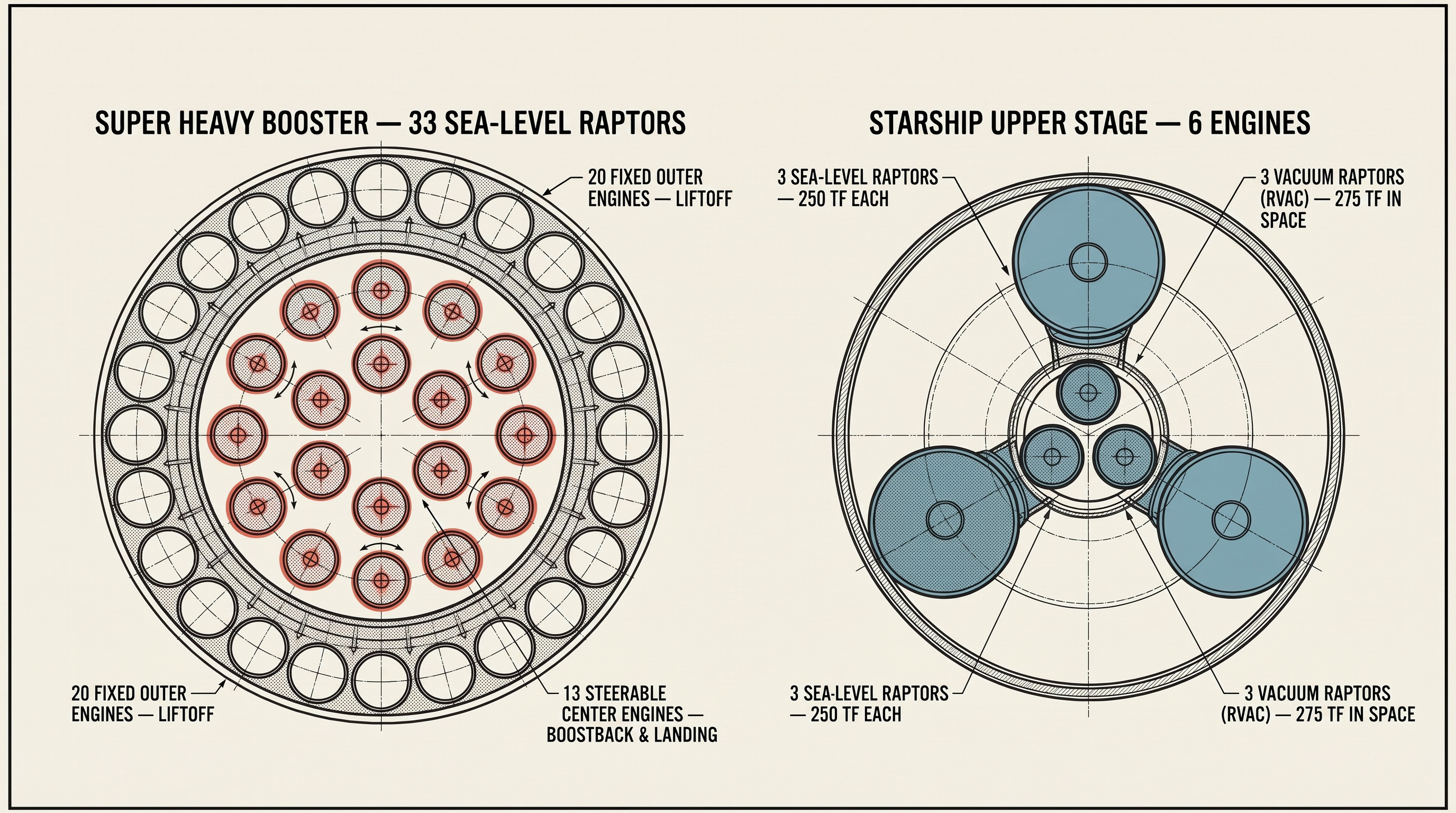
A cleaner engine only counts if it flies. Under the booster, an outer ring of 20 engines is fixed in place, and 13 center engines gimbal to steer and land the stage. Under the ship, three sea-level Raptors sit beside three vacuum Raptors (RVacs), which use larger nozzles to reach 275 tonnes of thrust in space.
Raptor has real flight history. On Flight 5, October 13, 2024, the launch tower caught a returning booster for the first time. On Flight 6, November 19, 2024, a Raptor relit in space for the first time.
The 2025 flights showed the open problems. SpaceX tied the Flight 7 ship loss to strong vibration (harmonic response) and propulsion leaks. On Flight 8, booster relights failed because of heat conditions at the torch igniters, and a center-engine hardware failure that mixed propellants by accident destroyed the ship. Leaks and igniters were the same problems the Raptor 2 redesign went after.
Raptor 3 first flew on Flight 12, May 22, 2026. All 33 booster engines lit. One shut down on the way up, the booster didn’t light all its planned boostback engines, and it splashed down hard. The ship lost one RVac and still reached its planned path. On Flight 13, July 24, all six ship engines finished the climb and one relit in space.
On Flight 14, September 28, Starship reached orbit for the first time. The booster relit 31 of 33 planned engines for boostback and 11 of 13 for landing. One ship RVac shut down early, and the others burned longer to make up for it. A sea-level Raptor did the orbital insertion burn, and the mission deployed 26 Starlink V3 satellites. Another single-engine burn brought the ship out of orbit, and all three sea-level Raptors lit for the landing burn.
As of October 30, 2025, SpaceX had built more than 600 Raptors, with over 226,000 seconds of Raptor 2 run time and over 40,000 seconds of Raptor 3. Forty thousand seconds is about 11 hours.
More Thrust from the Same Weight
Teslarati reported on October 26, 2026, that Musk’s target for Raptor 4 is 300 tonnes of thrust at roughly Raptor 3’s mass. I couldn’t find Musk’s original post, and no date, pressure, or test result is public. It’s a target, not hardware.
Notice the direction. The first two rounds took weight off. The next one, if it happens, holds the weight and adds thrust.
The Hidden Weight of Every Part
Steve Jobs did this to a whole company. Back at Apple in 1997, he drew four squares: consumer and pro, desktop and portable. Macworld later summed up the rule: “Anything that didn’t fit in that grid got cut.” Apple cut more than 70 percent of its hardware and software products, the Newton among them. It also ended the program that licensed Mac clones. Every product he cut took with it everything that existed only to build, sell, and support it. What was left, in Macworld’s words, was “a handful of good products, rather than a menagerie of mediocre ones.” To me, the grid is the same lesson as Raptor, applied to a company.
The part you remove is rarely the whole saving. The savings come from everything that part needed.