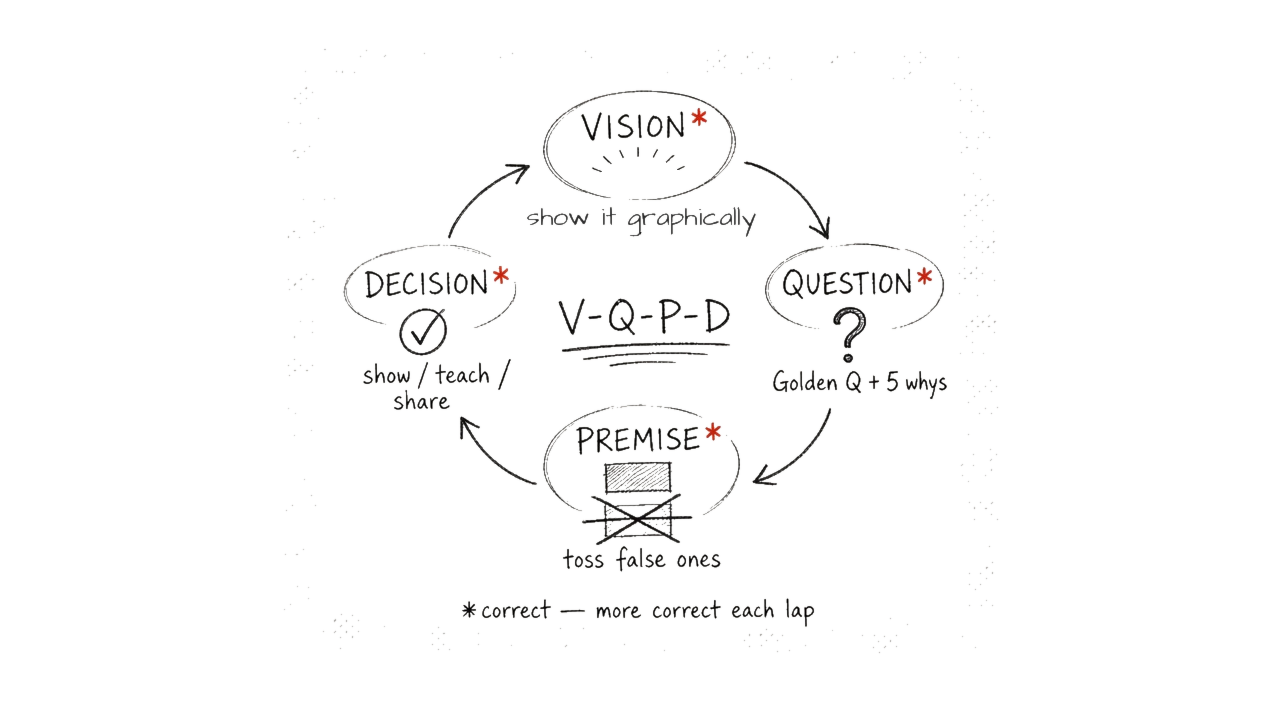
V-Q-P-D is a flywheel, not a checklist.1 Each step is its own way of thinking and doing, and each one feeds the next. It runs at every scale at once: a whole project, a single meeting, a single step of the loop. It's always running, even on itself.
Every step carries an asterisk, and the asterisk means correct: the correct vision, the correct question, the correct premise, the correct decision. None of them is correct on the first lap. Each lap gets more correct.
- Vision*Draw a picture.
Draw it, and everyone is finally talking about the same thing.
Do the work of making the problem visible, on a whiteboard, a poster, a screen or a napkin.2 Put the essential elements together in one place, so nobody has to hold the whole thing in their head while they work through the hard parts.
A picture can carry what would otherwise take a mountain of words to read, decipher and keep straight. It works for a room full of people, and it works for one person thinking alone.
I've sat in too many meetings without one. People go in circles, miss connections, talk past one another, and end up solving the wrong problem because nobody put the real one where everyone could see it. When the drawing is made together, the confusion clears. The right questions come sooner, the correct premise is easier to find, and the decisions hold up.
- Question*Golden Q + 5 Whys.
There's a reason the word question starts with quest.
Good questions are everything. We ask them so naturally that we miss how powerful they are. As with every step in the loop, the more correct the question, the higher it pushes you: better answers, more ground covered, a faster launch.
A golden question is one you work hard to get right.3 It doesn't come for free. It has to be developed. Sometimes it comes from diligent thinking, asking and thinking again. Sometimes it arrives as inspiration. Either way it takes effort, trying and seeking. It's a quest.
Then the 5 Whys:4 ask why, and then why again, drilling down until you reach the essential truths beneath the problem.
- Premise*Keep the true, toss the false.
Find the correct premise. Don't be seduced by a great plan.
Those essential truths are what a premise is made of. Reason from them, from first principles,5 instead of by analogy, habit or what the last project did. Truth-seeking comes first, and that includes being honest with yourself.6
Every plan rests on assumptions. Write them down and question each one. What has to be true for this to work? What are we taking for granted? Is there a simpler way? What would guarantee this fails?7 Keep what holds up and throw out the rest.
Get the premise wrong and everything built on it is a well-made mistake. I've seen it lead whole teams on wild goose chases and pour serious money into the wrong thing.
A case in point. A team was settling in for months of refactoring a major application. The plan was large, impressive and technically detailed, and it had come together quickly with an AI agent's help. It was presented as the only way to deliver what leadership had asked for.
Looked at through V-Q-P-D, it fell apart almost at once. Somewhere along the way the plan had replaced the original request with more interesting work, and then claimed that work was necessary. It wasn't.
Nobody had asked the golden questions. Is there a better way? Is all this churn really needed? Can this work with the simplest possible change? Weeks of planning never reached the correct premise.
I built a proof of concept in under an hour. It delivered leadership's request with no refactoring at all. We shipped the change, avoided months of effort and risk, kept the deadline, and met the original request in full.
- Decision*Decide, cut, draw again.
A correct decision on a bad premise is still the wrong answer.
A decision is only as good as the premise under it. You can reason perfectly, weigh every option and make the "right" call, and still be wrong. If the premise was false, a flawless decision just carries you more efficiently in the wrong direction.
With the correct premise in hand, decide for real, and decide to cut. Question every requirement and delete whatever doesn't serve the real need: parts, steps, features, code. Cut aggressively. If you never have to add anything back, you didn't cut enough. Simplify only what's left, because the costliest mistake is perfecting something that shouldn't exist.8
Most decisions can be undone, so make them and move.9 The next lap will correct them.
Then the wheel turns. Every decision becomes the next drawing: either a more accurate picture of the same idea, or a new idea worth drawing.
Vision, question, premise, decision. None of them is correct the first time around, and that's the point. Keep the wheel turning.
Notes
1. The flywheel. Jim Collins's flywheel: no single push makes the breakthrough. Momentum builds one turn at a time, each turn adding to the last. Good to Great (2001); Turning the Flywheel (2019).
2. Thinking visually. Dan Roam, The Back of the Napkin: Solving Problems and Selling Ideas with Pictures (2008).
3. Golden questions. Related work includes Hal Gregersen's "catalytic questions" in Questions Are the Answer (2018) and Warren Berger's A More Beautiful Question (2014).
4. The 5 Whys. The technique comes from Toyota. Its origins are credited to Sakichi Toyoda, and Taiichi Ohno described it as the basis of Toyota's scientific approach. Taiichi Ohno, Toyota Production System: Beyond Large-Scale Production (1988). Overview
5. First principles. Reason up from the most fundamental truths instead of by analogy, an approach Elon Musk has described repeatedly. APS News interview, 2013
6. Not fooling yourself. Richard Feynman, "Cargo Cult Science," Caltech commencement address (1974): "The first principle is that you must not fool yourself, and you are the easiest person to fool."
7. Inversion. Charlie Munger's "invert, always invert": ask what would guarantee failure, then avoid it.
8. Cut first, then simplify. Musk's five-step "algorithm": question every requirement, delete the part or process, simplify and optimize, accelerate, automate. "If you're not adding back at least 10%, you didn't delete enough." Walter Isaacson, Elon Musk (2023). Summary
9. One-way and two-way doors. Jeff Bezos, 2015 Amazon shareholder letter. Most decisions are reversible and should be made quickly. Save the slow, careful process for the few you can't undo.